Unexploded ordnance instills dread among Gazans under a tenuous ceasefire.
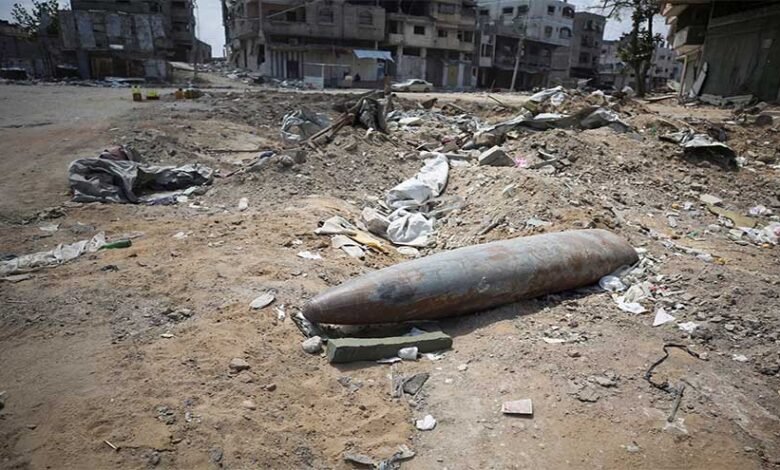
Moein al-Hattu’s residence has been devastated, its cinder block walls shattered and strewn across the street, while a dirty grey bomb ominously dangles from a damaged pillar, its tip precariously positioned on a crushed chest of drawers.
The munition, exceeding one tonne, was released during an airstrike on Gaza City amid hostilities between Israel and Hamas, but it has yet to detonate.
“I am engulfed in fear and unable to dispel it,” al-Hattu informed AFP, as children traversing the debris halted to gaze at the ominous presence.
The elderly Palestinian seeks to suspend tarpaulins from the remains of his destroyed residence and return, although he has been unable to locate anyone in Gaza with the necessary expertise or equipment to dismantle the large bomb.
The pertinent authorities, be it the civil defense or the municipality, assert their inability to remove it. To whom may I direct my complaint? He insisted.
“Had it exploded, it would have resulted in extensive devastation, obliterating at least five to six residences.”
Following two years of conflict, the devastated cities of Gaza, a densely populated region housing over two million Palestinians, are strewn with military remnants, including unexploded and still-lethal ordnance.
In the streets of Gaza City, children engage with rocket fragments and the tail fins of mortar rounds, either unaware of or indifferent to the peril.
A research by Handicap International indicates that Israel has deployed over 70,000 tonnes of explosives on targets in Gaza since Hamas’s cross-border assault on October 7, 2023, which initiated the protracted conflict.
Cardboard for culinary purposes
In January of this year, the United Nations Mine Action Service (UNMAS) cautioned that five to ten percent of these explosives failed to detonate, leaving their lethal contents vulnerable to retrieval by terrorists or discovery by apprehensive civilians.
At Al-Shifa Hospital in Gaza City, Mohammed Nour sat by a bed with his two injured children.
The duo observed silently and with vacant expressions, their legs restrained and flesh marked with shrapnel as he detailed the circumstances of their injuries.
“As we were erecting our tents, the boys ventured to procure wood, nylon, and cardboard for fuel to facilitate cooking,” Nour informed AFP.
Approximately ten meters from our position, we abruptly witnessed youngsters being propelled by the explosion. We did not perceive them as our offspring, however we discovered them dispersed in every nook.
Nour’s sons may retain their limbs; nevertheless, in an adjacent bed, six-year-old Yahya has suffered the loss of part of his right hand and is nearly enveloped in bandages. His grandfather, Tawfiq al-Sharbasi, sits beside him, maintaining a vigil and caressing his hair.
These individuals are minors. What was their error? “They were engaged in play,” he stated.
Jonathan Crickx, spokesperson for UNICEF Palestine, informed AFP that it is exceedingly challenging to ascertain the number of children harmed by unexploded munitions.
“Subsequent to the recent ceasefire, reports indicate that at least eight children sustained severe injuries from explosive remnants of war,” he stated, noting that UN organizations are endeavoring to heighten awareness of the danger.
As of yet, the Israeli army has not authorized any demining equipment to enter the Gaza Strip.