Afghan claims of cross-border airstrikes are denied by DG ISPR.
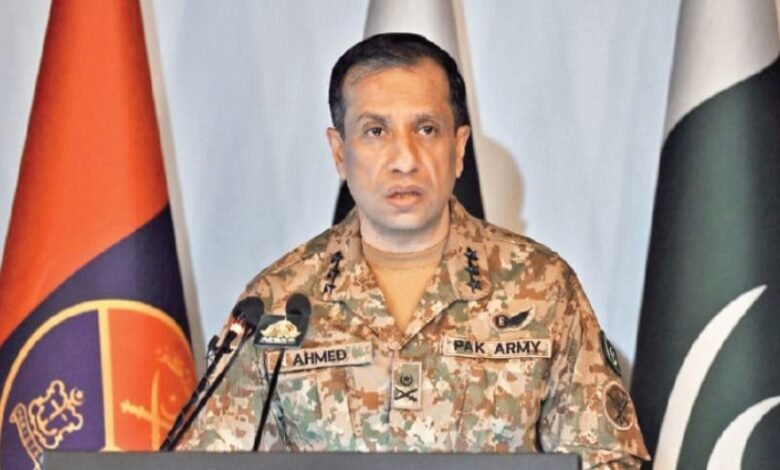
Pakistan vehemently denied claims made by Afghanistan’s interim government on Tuesday that it had carried out lethal attacks within Afghan territory.
Lieutenant General Ahmed Sharif Chaudhry, Director General of Inter-Services Public Relations (ISPR), denied the allegations, stating that Pakistan had neither attacked Afghanistan or targeted civilians in areas such as Khost, Kunar, and Paktika, as Kabul had claimed. Taliban spokesman Zabihullah Mujahid had charged Islamabad of attacking a civilian residence in Khost, killing nine children and a woman, according to reports.
Lt-Gen Chaudhry emphasised during a media briefing that Pakistan never takes covert action, saying that all military acts are publicly announced and acknowledged. He stressed that Pakistan adheres to state ideals and never targets civilians—only terrorists. “There are no good or bad Taliban; there is no distinction among terrorists,” he emphasised, highlighting Pakistan’s unwavering stance.
Noting that it is still unclear how long the current setup in Afghanistan will remain an interim administration, he urged the Afghan authorities to behave like a responsible state rather than a non-state actor. He also demanded that non-custom-paid cars be prohibited because of their regular involvement in terrorist attacks.
The comments came after three officers were murdered and eleven others were injured in a suicide attack on the Federal Constabulary Headquarters in Peshawar. Based on retrieved evidence, including fingerprints, CCTV footage, and images, investigators concluded that the attackers were most likely Afghan nationals.
The 2,500-kilometer porous border between Pakistan and Afghanistan has several crossing locations that are essential to regional trade, travel, and cultural exchanges. However, the existence of the outlawed Tehreek-i-Taliban Pakistan (TTP), which Islamabad claims has been let to operate from Afghan territory, has caused ties to worsen. A study by the United Nations Security Council Analytical Support and Sanctions Monitoring Team backed up these allegations, stating that the Taliban government had given the TTP financial, logistical, and operational support.
Talks to reduce tensions were started thanks to diplomatic efforts by Qatar and Turkiye, but they ended without a settlement in November. Following this, trade contacts were halted, and Pakistan associated any restoration with Kabul’s pledge to eradicate cross-border terrorism. Important regional energy projects that depend on Afghanistan’s participation have also been impacted by the problem.
Court of Faiz Hamid
The DG ISPR also discussed the ongoing court martial procedures against retired Lieutenant General Faiz Hamid, the former Director General of ISI. “The case is being handled under strict legal parameters, and any final outcome will be announced immediately once reached,” he said, warning against speculation.
DG ISPR advises against speculating on the Faiz Hamid court martial case.
In August 2024, Faiz Hamid was placed under military captivity. In December 2024, the army revealed that he had been charged with political activities, abuse of power, and breaking the Pakistan Army Act’s anti-espionage provisions. His case is based on a Supreme Court decision that ordered an investigation into accusations made by the owner of the Top City housing association, who claimed that items had been seized during a search in 2017.
It is one of the most prominent court martial cases in Pakistani military history because Hamid is the first former head of the ISI and just the second three-star general to face it. According to military law, he has the right to retain legal counsel after being indicted.