Remarkable cosmic butterfly with luminous ‘wings’ captured at a distance of 3,800 light-years
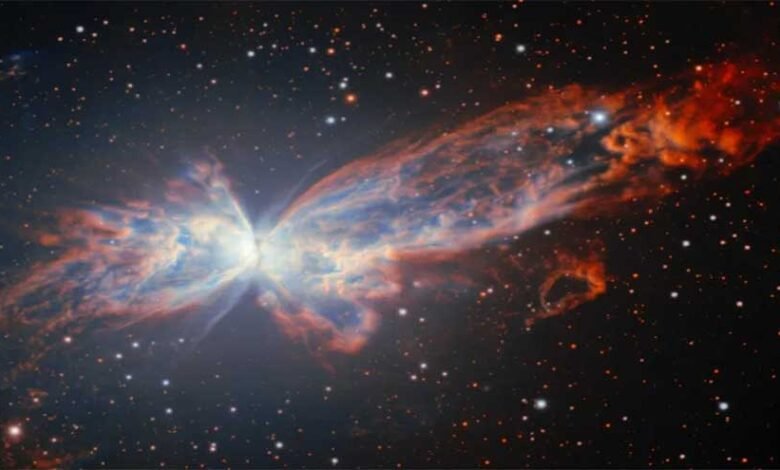
Astronomers have observed a remarkable cosmic butterfly with luminous “wings” in the depths of space. The astonishing phenomenon is, in fact, a highly luminous white dwarf star that has previously expelled its outer gaseous layers. Researchers from the International Gemini Observatory in Chile unveiled the stunning image to commemorate the 25th anniversary of the construction of their substantial Gemini South telescope. The photograph was captured last month and chosen by local schoolchildren for dissemination to commemorate the memorable event. Officially designated as NGC 6302, the bipolar planetary nebula is located between 2,500 and 3,800 light-years from Earth in the constellation Scorpius. A single light year is approximately six trillion miles. Prior to its transformation into a white dwarf, the star at the center of this image was an immense red giant, measuring 1000 times the diameter of our Sun. Currently, as a white dwarf, it emits strong radiation, heating the wing-like region depicted in the photograph to almost 20,000°C and producing a luminous look. A planetary nebula is an emission nebula formed from a giant star nearing the end of its life, spewing material and encased in an expanding, luminous shell of ionized gas, as elucidated by NOIRlab. “Typically, these captivating structures possess a planet-like spherical shape, which is the reason they were designated ‘planetary nebulae’ by the early astronomers who observed them through telescopes.” The Butterfly Nebula resembles a winged creature in mid-flight rather than a spherical planet. The creation of this distinctive structure is propelled by a star at the nebula’s core, which is expelling layers of gas and dust as it approaches the conclusion of its life cycle. Throughout the years, the Gemini South telescope has observed numerous astonishing phenomena in space, including galaxies and asteroids. Recently, it has been monitoring the enigmatic 3I/ATLAS comet.