Treasury Members of Parliament receive Rs43 billion.
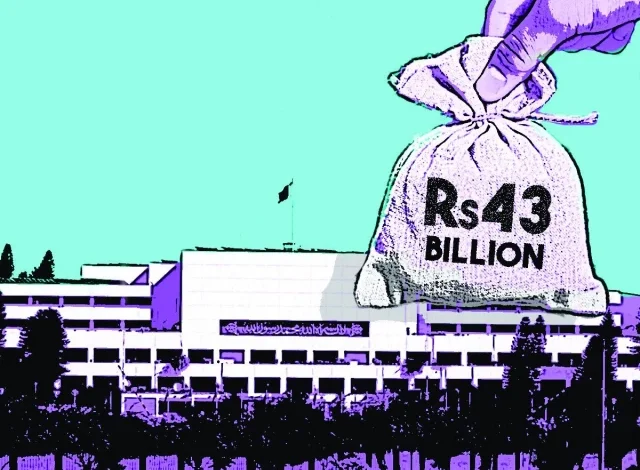
The government has sanctioned the disbursement of Rs43 billion to allocate Rs250 million to each member of the National Assembly from treasury benches for developmental expenditures, since the International Monetary Fund (IMF) asserts that such expenditures disproportionately favor districts represented by the ruling parties.
Government sources informed The Express Tribune that a steering group for the Sustainable Development Goals Achievement Programme (SAP) sanctioned the disbursement of Rs43 billion for lawmakers. It was said that financial resources would be allocated to minor development projects in the constituencies of parliamentarians from the ruling coalition for the fiscal year 2025-26.
The Rs43 billion expenditure is a component of a Rs50 billion package, which the SAP sanctioned in August 2025 for initiatives proposed by lawmakers. Deputy Prime Minister Ishaq Dar presides over the steering group responsible for determining the allocation of discretionary expenditures among National Assembly members.
Funding was authorized weeks prior to the ratification of the 27th Constitutional Amendment. The government allocated discretionary funding to the ruling party members of parliament in the previous fiscal year.
According to sources, of the Rs43 billion, the majority, amounting to Rs23.5 billion, has been allocated for MPs’ initiatives in Punjab. The province, governed by the PML-N, will receive 54.5% of the total funds. A substantial portion of Rs17.6 billion will be allocated by the government of Punjab, as per sources.
The federal government would allocate Rs5.9 billion in Punjab for village electrification initiatives. An additional Rs40 million will be allocated via the Defence Division, as per the decision.
The current Governance and Corruption Diagnostic Assessment by the IMF critically examines discretionary spending. The IMF emphasized that the federal government possesses considerable discretionary authority regarding the allocation of public funds, due to substantial discrepancies between approved budgets and actual expenditures, within a context characterized by restricted public transparency and minimal parliamentary involvement in budgetary issues.
The IMF stated, “Discretionary allocations are biased towards districts represented in the government or senior bureaucracy, highlighting the system’s susceptibility to political influence.”
Since the 1980s, expenditure on initiatives proposed by parliamentarians has served as a mechanism for exerting influence.
The IMF stated that in 2013, the Supreme Court of Pakistan rendered a decision regarding the interpretation and implementation of Article 84 of the Constitution about the discretionary powers conferred upon the federal government regarding fiscal matters. This was launched by a petition to the Supreme Court, requesting a ruling on whether the constitution permits the executive to allocate cash through extra grants at its own discretion.
The IMF stated that rule-based governance is frequently undermined by the arbitrary distribution of economic benefits to influential individuals and state-linked organizations, contributing to institutional complexity and opacity.
According to sources, of the Rs43 billion, MPs from Sindh will receive Rs15.3 billion for allocation to their selected projects. This constitutes 35.5% of the total. According to sources, Rs10.9 billion would be allocated by the government of Sindh, while Rs4.3 billion will be provided by the Pakistan Infrastructure Development Company.
Khyber-Pakhtunkhwa, where the governing coalition has a minimal presence, will receive Rs1.3 billion, according to sources. Of this amount, Rs940 million will be allocated via the Pakistan Infrastructure Development Company, while an additional Rs310 million will be utilized for electricity supply initiatives.
The government has authorized the disbursement of Rs2.3 billion for the initiatives to be implemented in Balochistan. The total sum will be disbursed via the provincial government.
The federal capital area would receive Rs750 million as its allocation, designated for expenditure in the seats of three National Assembly members, according to sources. The substantial portion of Rs700 million will be allocated via the local administration, while the remainder would be utilized by the Power Division, they stated.
Concerns have arisen regarding the effective utilization of these monies, as the schemes are not subjected to standard vetting processes.
Subsequent to the steering committee’s resolution, the funds are transferred to the Cabinet Division, which subsequently allocates them to the individual provinces for expenditure. The Planning Commission disburses the total sum in a single payment to the Cabinet Division.