China launches satellites in a commercial space mission for the United Arab Emirates, Egypt, and Nepal.
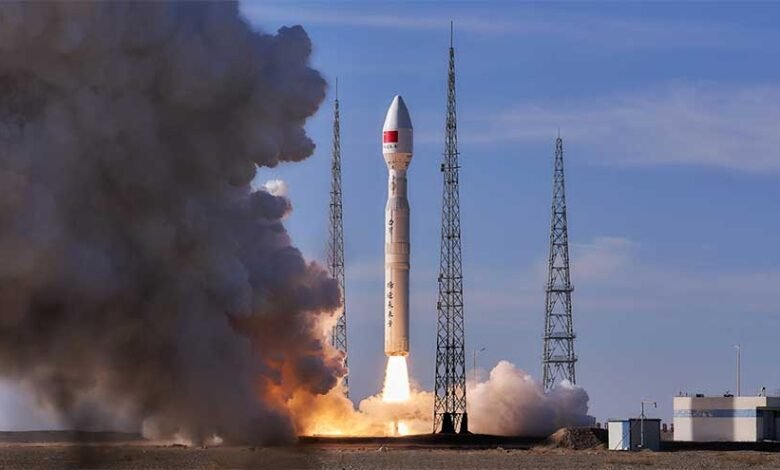
China launched the Lijian-1 Y11 carrier rocket on Wednesday, carrying nine satellites, including three international payloads for Egypt, Nepal, and the United Arab Emirates (UAE).
The launch mission was deemed a total success once the nine satellites were delivered to their designated orbits.
The Chinese Academy of Sciences (CAS) owns the majority of the satellites, which the rocket manufacturer CAS Space claims would help applications such as meteorology, water resources, urban planning, and disaster detection and mitigation.
The Shanghai-based Innovation Academy for Microsatellites of CAS produced the “UAE-813 Satellite,” which was launched in the mission on Wednesday, according to Global Times. It is a spacecraft for hyperspectral Earth monitoring. Along with the development of equivalent ground equipment, its main payloads are an atmospheric polarization corrector, a panchromatic camera, and a hyperspectral imager.
According to CAS Space, the project’s primary goal is to develop hyperspectral remote sensing capabilities, which will effectively support scientific research and environmental monitoring.
The Egyptian Space Agency and the Egyptian Academy of Scientific Research and Technology collaborated to construct the SPNEX satellite, which was also on board the Lijian-1 rocket on Wednesday during the flight mission. Its main objective is to monitor the effects of ionospheric fluctuations and climate change. It carries payloads for Earth observation and plasma diagnostics.
Antarikchya Pratisthan Nepal and the Amateur Radio Digital Communications Foundation collaborated to launch the educational Slippers2Sat (S2S) satellite. The project’s goal is to uplift, encourage, and promote low-income communities, indigenous people, and marginalized groups in Nepal through education.
In addition to demonstrating and promoting a software-based digital repeater system in amateur radio bands for users worldwide, the project’s primary objective is to assist Nepali junior-high students with autonomously designing and building the country’s third 1U CubeSat.
As of right now, 32 satellite clients—26 domestic and six foreign—have been supplied by CAS Space. China, Europe, North America, South Asia, the Middle East, North Africa, and other nations and regions are all included in its launch-service footprint.