Pakistan experiences substantial growth in seafood exports.
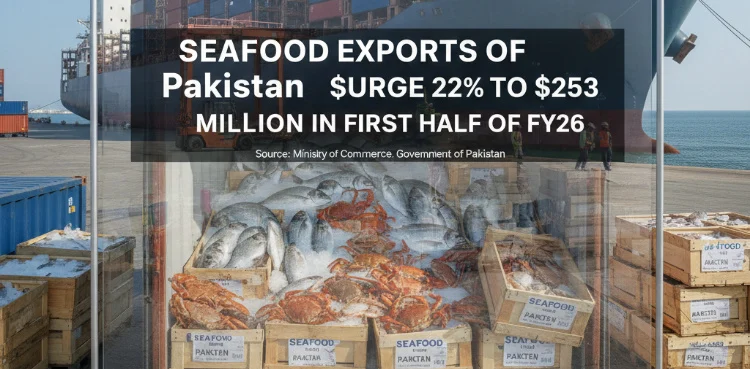
The Federal Minister for Maritime Affairs of Pakistan, Muhammad Junaid Anwar Chaudhry, announced that the marine fisheries sector experienced significant growth in the first half of the fiscal year 2025–26, with seafood exports reaching 122,629.11 metric tons, valued at $253.24 million, from July to December 2025.
Muhammad Junaid Anwar stated that the performance indicates the increasing competitiveness of Pakistan’s marine fisheries in international markets, highlighting consistent export momentum during the time.
In comparison to the equivalent period of FY2024-25, during which exports totaled 102,942.05 metric tons valued at $208.25 million, the industry had a year-on-year growth of 19.1 percent in volume and 21.6 percent in value.
Data indicates that frozen fish was Pakistan’s predominant export category, totaling 26,669.37 metric tons with a value of $53.33 million.
Shrimps and prawns yielded earnings of $40.46 million, but frozen cuttlefish produced $36.13 million. Additional goods such as shrimp meal, crabs, sardines, mackerel, flatfish species, and fish meal significantly enhanced export revenues, highlighting diversification and advancements in value-added processing.
China remained Pakistan’s biggest seafood market, accounting for approximately 59% of total export value. Thailand secured the second position, primarily due to the demand for shrimp and prawns, followed by the United Arab Emirates, Malaysia, and Japan.
The federal minister stated that market diversification initiatives had increased exports to the European Union, Saudi Arabia, Vietnam, Kuwait, and the United States.
Monthly export data demonstrated steady growth, culminating at $56.42 million in November and $55 million in December, supported by seasonal demand and enhanced logistics. Non-tax earnings from the fishing sector rose to Rs127.7 million (about $460,000), an increase from Rs118 million the previous year.
Muhammad Junaid Anwar characterized fisheries as an essential component of the national maritime economy, sustaining hundreds of thousands of livelihoods in coastal villages throughout the Arabian Sea, especially in Sindh and Balochistan.
The sector, which historically contributed approximately one percent to GDP, has recovered from pandemic-related disruptions by enhancing processing capacity, optimizing cold-chain logistics, and implementing tougher certification in accordance with international standards.
Muhammad Junaid Anwar stated that the government is collaborating with international partners, including the International Maritime Organization, to advance sustainable fishing techniques and is investing in port facilities in Karachi and Gwadar.
He recognized persistent issues, including climate-related effects on migratory species, while observing that innovative methods such as eDNA monitoring and comprehensive blue economy plans are gaining traction as Pakistan conforms with IMO standards and enhances regional collaboration.