Report: 25 million children are still not attending school.
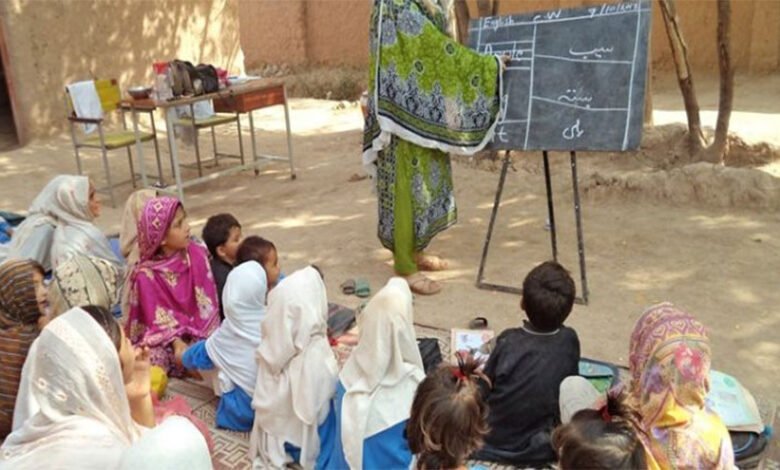
The Institute of Social and program Sciences (I-SAPS) analysis shows that 25 million childrensare still not in school, exposing the government’s education emergency program.
The government’s education emergency program contains flaws, according to a recent analysis from the Institute of Social and program Sciences (I-SAPS).
The research claims that although the nation has spent Rs 500 billion on education overall, the government no longer bears the majority of this expense; instead, average Pakistani families do.
According to the I-SAPS research, home education spending has surpassed the government’s education budget for the first time in the nation’s history. The 15th edition of the report states that over 25 million youngsters are still not enrolled in school.
According to statistics, government expenditure in education has decreased to Rs 220 billion, while the public spends Rs 280 billion. Because of this, the public bears 56% of the cost of education, while the state only bears 44%.
According to the report, parents must pay Rs 1,310 billion for private school fees, Rs 613 billion for tuition and coaching, and Rs 878 billion for various costs associated with their own education.
I-SAPS Executive Director Dr. Salman Humayun stated at a policy discussion that a significant equity dilemma is present when family education spending exceeds government investment.
The rising popularity of private schools is proof that families are opting out of the public education system, according to Aza Farukh, Senior Education Specialist at the World Bank.
“The increase in spending on private education sends a clear policy message to the government,” said Ahmed Ali, Director of Programs at I-SAPS. According to him, the public education system has to be strengthened.
Effective use of resources is necessary, he continued, with an emphasis on guaranteeing educational parity for girls and underserved communities.