“Civilian lives remain at risk”: Pakistan expresses worries over the precarious situation in Gaza
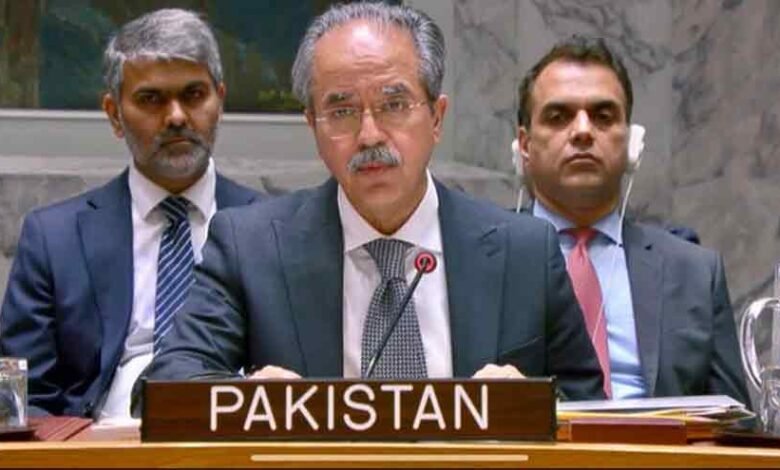
Asim Iftikhar Ahmad, Pakistan’s Permanent Representative to the UN, expressed profound worry about the precarious situation in Gaza, where ceasefire violations are still occurring unchecked and civilian lives are still at danger.
He stated during a discussion on the Middle East, including the Palestinian Question, that “increased pressure on international humanitarian organizations, including deregistration measures and restrictions on humanitarian operations are impeding assistance and protection for the most vulnerable.” This statement was made in conjunction with the UN Security Council’s announcement of the 26-member Board of Peace (BoP).
Pakistan informed the UNSC that it has joined the US-led Board of Peace (BoP) in affirming its commitment to efforts to achieve a lasting peace based on Palestinian statehood and self-determination in accordance with international law, as stated in the 15-member body’s resolution 2803.
Ambassador Asim Iftikhar stated, “The international community, especially this Council, bears the responsibility to translate renewed engagement into measurable change on the ground for the betterment of the Palestinian people.”
He emphasized that decades of Israeli occupation have led to eviction, persecution, and the denial of the Palestinian people’s right to self-determination, and that the unresolved Palestinian question continues to be at the heart of Middle East instability.
The Pakistani envoy noted that the start of the second phase of the Peace Plan, which included the creation of the BoP and Executive Committees as well as the National Committee for the Administration of Gaza (NCAG), were “important steps.” These actions should now help consolidate the ceasefire, secure a permanent cessation of hostilities, facilitate transitional arrangements, enable recovery and reconstruction, guarantee the provision of humanitarian assistance at scale, and prepare the ground for a sustainable and credible political process toward Palestinian self-determination and statehood.
Along with strongly denouncing Israel’s ongoing attacks on UNRWA, its agency for aiding Palestinians, and the recent demolition of the UN compound in the Sheikh Jarrah neighborhood of occupied East Jerusalem, the Pakistani envoy also said that such actions jeopardize the limited progress made thus far and undermine stabilization efforts. “UNRWA’s operations are vital and need to be protected.”
He cited a joint statement released by the group’s foreign ministers reaffirming their support for the peace initiatives spearheaded by US President Donald Trump, noting that Pakistan, along with other Arab and Islamic nations in the group of eight, has joined the Board of Peace in support of its mandate as endorsed by the Security Council resolution 2803.
In that statement, the foreign ministers reaffirmed their commitment to carrying out the Peace Board’s mission as a transitional administration, as outlined in the Comprehensive Plan to End the Gaza Conflict and approved by resolution 2803. This task includes advancing a just and lasting peace based on the Palestinian right to self-determination and statehood in accordance with international law, supporting the reconstruction of Gaza, and consolidating a permanent ceasefire. This will pave the way for security and stability for all nations and peoples in the region.
A permanent ceasefire, increased humanitarian aid, Gaza reconstruction, and the realization of the Palestinian people’s right to self-determination through a credible, time-bound political process that is consistent with international legitimacy and pertinent UN resolutions are all goals Ambassador Asim Ahmad hoped the BoP would pursue under resolution 2803. This would result in an independent, sovereign, and contiguous state of Palestine based on pre-1967 borders, with Al-Quds and Al-Sharif as its capital.
“The world community supports that as the ultimate goal. The Pakistani ambassador stated that Palestinian-led governance and institutional strengthening, with the Palestinian Authority playing a key role, are essential in this respect.