Pakistan urges the UNSC that treaties should not be undermined by geopolitical factors amidst violations of the Indus Waters Treaty.
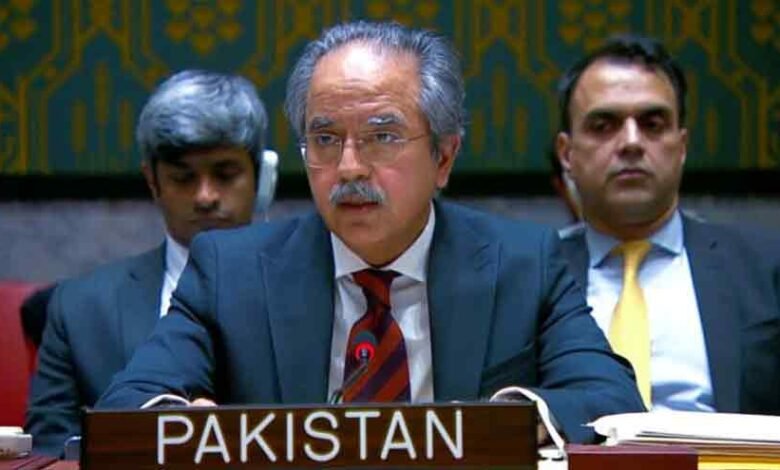
Asim Iftikhar Ahmad, Pakistan’s Permanent Representative to the United Nations, stated that treaties should not be compromised by geopolitics; rather, they should serve as anchors of restraint, avenues for cooperation, and safeguards for peace.
Ambassador Asim Iftikhar Ahmad made this statement while presiding over a UN Security Council meeting conducted in the Arria-Formula format. Over 40 delegations and experts participated in the event.
During the meeting, speakers underscored the essential principle of ‘pacta sunt servanda’—the necessity of honouring agreements—to uphold global stability and adhere to international law, with Pakistan highlighting India’s unilateral suspension of the 1960 Indus Waters Treaty (IWT) between the two South Asian nations.
The speakers reiterated the obligatory nature of treaties under international law during the 15-member meeting held by Pakistan, a development widely seen as timely and significant within a challenging political context.
Arria-Formula meetings, named after a previous Venezuelan UN ambassador, are informal gatherings that facilitate candid and private discussions among Security Council members on pertinent topics.
The topic of Friday’s meeting was “Upholding the Sanctity of Treaties for the Preservation of International Peace and Security.”
The Pakistani envoy stated at the outset of the debate, “Treaties are not ceremonial texts; they constitute the operating system of peaceful international relations.”
Ambassador Asim Ahmad said, “When the lifelines of millions are subject to unilateral discretion, the risks are not hypothetical — they are tangible and urgent,” emphasising the detrimental effects of disrupted water flows on downstream populations.
He remarked that the International Court of Justice has consistently upheld that ‘good faith is a fundamental principle governing the establishment and execution of legal obligations,’ asserting that disputes should be resolved through mutually accepted legal mechanisms rather than through unilateral actions that disrupt the equilibrium of rights and obligations.
“Today, however, we observe a concerning trend,” he stated, as treaty obligations are increasingly prone to selective interpretation, postponed execution, suspension, or unilateral claims of being held in abeyance.
The Pakistani envoy stated, “Legal uncertainty transforms into political risk; political risk evolves into security risk,” emphasising that the erosion of treaties leads to a decline in legal certainty and an increase in strategic ambiguity.
Preventive diplomacy is undermined, and regional tensions are exacerbated. Unresolved political issues, especially in sensitive regions, become increasingly volatile.
The Indus Waters Treaty is usually considered one of the most robust water-sharing agreements globally.
“For more than sixty years, it has endured various challenges, including wars, crises, and profound political tensions between India and Pakistan, notably the protracted dispute over Jammu and Kashmir,” stated Ambassador Asim Ahmad.
The durability of IWT is attributed to its design, which features a meticulously balanced distribution of rights and obligations, institutionalised collaboration, and clearly defined, multi-tiered dispute resolution mechanisms aimed at ensuring that conflicts are addressed through legal frameworks and expertise rather than unilateral actions.
India’s unilateral suspension of IWT constitutes a “serious deviation” from established legal and historical precedents, eroding a longstanding confidence-building framework in a nuclearized area and introducing uncertainty into the governance of a shared, essential resource.
Any unilateral alteration to established water-sharing agreements has humanitarian, environmental, and peace-and-security ramifications, especially for the 250 million downstream inhabitants of Pakistan. The unilateral control over the lifelines of millions renders the associated risks tangible and urgent.
In August 2025, he noted that the Court of Arbitration rendered significant rulings, affirming that the Indus Waters Treaty remains effective, its dispute-resolution processes are obligatory, and no party possesses the legal capacity to unilaterally suspend or invalidate it.
The Pakistani envoy stated, “This issue transcends bilateral interests; it serves as a litmus test for the international system.” He emphasised that if a binding treaty regulating shared natural resources can be unilaterally disregarded, then no agreement is genuinely shielded from geopolitical influences and various manipulations.
He stated that the United Nations, especially the Security Council, has a crucial role in prevention.
Maintaining international peace and security necessitates not only addressing crises post-eruption but also safeguarding the legal structures that avert their occurrence initially. The Pakistan envoy stated, “Adherence to treaties should be considered a strategic necessity for the prevention and resolution of conflicts.”