Influenced by Trump, US allies are recalibrating their relations with China.
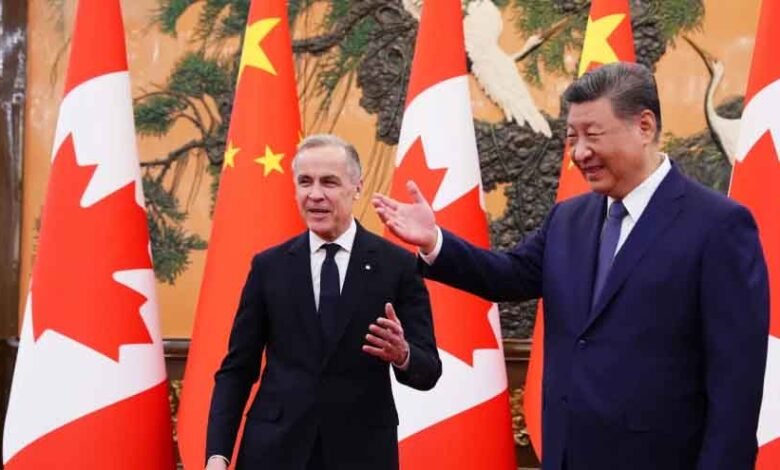
Chinese President Xi Jinping has recently engaged with Western allies aiming to foster closer relations with the world’s second-largest economy.
Canadian Prime Minister Mark Carney negotiated a trade agreement reducing tariffs on Chinese electric automobiles and Canadian canola oil.
U.K. Prime Minister Keir Starmer arrived in Beijing this week to mend relations that have deteriorated over the years, while German Chancellor Friedrich Merz is anticipated to visit next month. Finnish Prime Minister Petteri Orpo was also one of the most recent European leaders to engage in a handshake with Xi.
In a significant alteration to the global order since President Donald Trump’s re-election, America’s closest allies are seeking possibilities with China after confrontations with Trump regarding tariffs and his insistence on acquiring Greenland from NATO ally Denmark. Despite the potential to antagonise Trump, they are recalibrating relations with a nation historically regarded as a primary foe by numerous Western friends and the foremost economic competitor to the U.S.“We are engaging comprehensively and strategically with awareness,” Carney stated at the World Economic Forum gathering last week in Davos, Switzerland, shortly after his return from Beijing. “We confront the world as it exists, rather than awaiting the world we desire.”
Certain leaders, legislators, and specialists express concern over a shift that may advantage Beijing to Washington’s detriment, while others assert that China poses an equal challenge to the U.S., as both nations exercise influence to further their own goals. The alignment of countries with the world’s two superpowers is evolving.
“Rather than forming a cohesive alliance against China, we are driving our closest allies into their embrace,” stated U.S. Senator Jeanne Shaheen, the leading Democrat on the Senate Foreign Relations Committee, during a hearing this week.
In response to a reporter’s enquiry regarding Starmer’s visit to Beijing, Trump remarked that it was “extremely perilous for them to undertake such an action.”
Trump stated, “I believe it is even more perilous for Canada to engage in business with China,” noting his anticipated visit to Beijing in April. Canada is experiencing difficulties. They are performing exceedingly poorly. China should not be regarded as the solution.
Kaja Kallas, the European Union’s foreign policy leader, recognised that China presents a long-term challenge due to its “economic coercive practices,” but emphasised the importance of engaging with diverse relationships globally.
As Europe reevaluates its geopolitical approach, Una Aleksandra Bērziņa-Čerenkova, deputy director of the Latvian Institute of International Affairs in Riga, stated, “it’s not a China pivot.”It represents a shift towards Europe collectively safeguarding its interests.
The dilemma Europe faces about the United States and China
In an effort to circumvent EU leadership in Brussels, Beijing is establishing direct engagements with individual European cities, stated Alicia Garcia Herrero, an Asia-Pacific economist at the French investment firm Natixis and a specialist in Europe-China relations.
China aims to maintain the status quo with Europe: facilitating access to wealthy consumers while providing few concessions to European enterprises in the Chinese market, she stated.
“They require Europe, yet they do not need to contend for it,” stated Garcia Herrero.
Tim Rühlig, a senior analyst at the European Union Institute for Security Studies in Paris, perceives an irrevocable transformation in Europe’s connections with the two major global economies.
“Greenland has been significant for the United States.” He stated, “For China, the October rare earth export restrictions have been significant.” “In my opinion, both developments have significantly fostered a European awareness of two major powers that are unreserved in their intimidation of the EU.”
European leaders are visiting China for similar reasons as Trump: China’s substantial economy, its influence in global matters, and the necessity to build dependable communication channels.
“All individuals travel to Beijing, including the individual opposed to our visit to China,” stated Joerg Wuttke, former president of the EU Chamber of Commerce in China and current partner at the consulting DGA Group.
Canada is at the forefront.
In 2024, Justin Trudeau, the Prime Minister of Canada, collaborated closely with the Biden administration to impose a 100% tariff on Chinese electric automobiles to safeguard the U.S. automotive sector.
During Carney’s notable visit to Beijing this month—the first by a Canadian prime minister in eight years—he reduced the tax in exchange for decreased import rates on Canadian agricultural exports. Carney characterised the Canada-China trade relationship as “more predictable,” implicitly criticising Trump’s tariff threats against Canada.
Following Carney’s return, Trump threatened to implement a 100% tariff on Canada for its trade agreement with China. Carney characterised it as a bluster.
In Davos, Carney denounced the coercion exerted by major powers on smaller nations, without explicitly naming Trump. “Middle powers must collaborate, for if we are not included in the discussions, we risk becoming the subject of exploitation,” he stated.
Those words have reverberated throughout Europe.
European countries are re-evaluating their relationships with Beijing.
Starmer made a significant advancement this week by becoming the first British prime leader to visit China in eight years. The nations have been in conflict over matters such as security, Chinese technology, and Beijing’s suppression of pro-democracy demonstrations in the former British territory of Hong Kong.
This week, Starmer and Xi advocated for a strategic collaboration. “Collaborating on matters such as climate change and global stability during tumultuous periods is exactly what we ought to pursue as we cultivate this relationship as I have articulated,” Starmer conveyed to Xi in Beijing.
The journey has produced numerous corporate declarations and governmental accords, including reduced Chinese tariffs on Scotch whisky and a 30-day visa exemption for British tourists and business travellers to China.
Days prior, Finnish Prime Minister Orpo convened with Chinese Premier Li Qiang to formalise an agreement for collaboration in sustainable building, energy, and animal disease management.
A statement from the Finnish government indicated that Orpo urged China to assist in attaining enduring peace in Ukraine, acknowledged the trade imbalance, and highlighted human rights concerns.
In recent weeks, French President Emmanuel Macron, Irish Prime Minister Micheál Martin, and South Korean President Lee Jae Myung have also made visits.
Merz is scheduled to visit Beijing for the inaugural time as Chancellor of Germany. He has adopted a more stringent position on China than his predecessors and is anticipated to recalibrate relations while addressing certain national concerns: the trade deficit and reliance on China for essential minerals.
As Europe and other U.S. allies gradually align with Beijing, several commentators caution against perilous rifts inside the West.
Scott Kennedy, a senior consultant for Chinese business and economics at the Centre for Strategic and International Studies, stated, “It will be unfeasible for the U.S. and Western nations to collectively isolate China or establish and enforce conditions for connectivity and cooperation.”