The NCP industrial expo signifies a pivotal advancement in Pakistan’s innovation initiative.
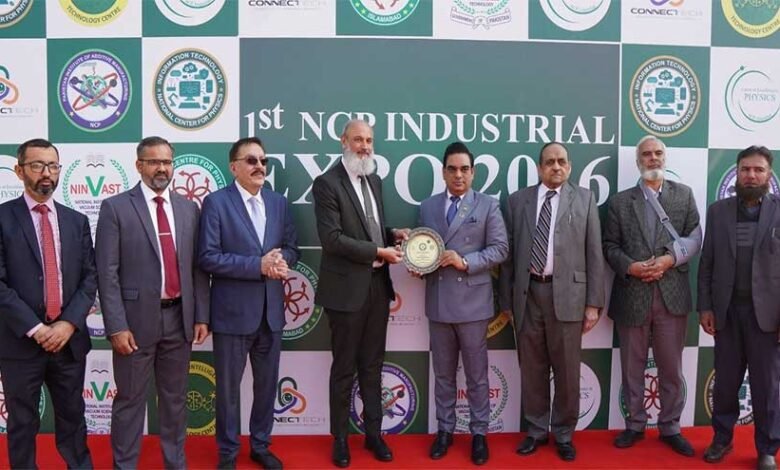
The National Centre for Physics (NCP) successfully ended its inaugural Industrial Expo 2026, a significant event that showcased Pakistan’s advancing capacity to convert scientific research into industrial applications and bolster its knowledge-based economy.
The two-day Expo, commenced on Wednesday, drew policymakers, entrepreneurs, manufacturers, academics, researchers, and emerging innovators. It highlighted NCP’s accomplishments in applied science, commercialization, and entrepreneurship, illustrating the institution’s transformation from a purely research-oriented entity into a multidisciplinary center of innovation.
Highlighted successes included improved physics apparatus, detector development, materials synthesis, and specialized training in computational physics.
The IT Directorate and Centres of Excellence of NCP introduced prototypes and products designed for industry and startups, encompassing artificial intelligence systems for health management, drone-based yield estimation, cloud seeding technologies, cybersecurity solutions, and wire bonding facilities for electronics manufacturing.
The event showcased advancements in 3D printing and vacuum science, presenting industry-ready solutions derived from extensive research.
These technologies are now accessible for implementation, enabling Pakistan to commercialize and export indigenous inventions.
These innovations signify NCP’s transformation from a purely research-focused institution into a multidisciplinary center of applied science, commercialization, and entrepreneurship, originating from Physics and now encompassing distinct domains such as Artificial Intelligence, Additive Manufacturing, and Vacuum Sciences, all interconnected by Information Technology.
During the concluding session, NCP Director General Dr. Qaisar Ahsan praised the Expo as a significant achievement in enhancing industry-academia connections.
He stated that the platform integrates government, industry, academia, and youth—the foundational elements of Pakistan’s innovation ecosystem—and underscored that collaboration is essential for sustained prosperity and technical self-sufficiency.
The Islamabad Chamber of Commerce and Industry has contributed to the facilitation of B2B matchmaking and networking sessions.
ICCI President Sardar Tahir Mehmood stated that the Expo facilitated live demonstrations, technical talks, collaborative project planning, and the development of enduring alliances, emphasizing that economic advancement relies on successful cooperation among research, entrepreneurship, and industry implementation.
The Expo provided industries, students, professionals, and the public a unique opportunity to observe Pakistan’s technology-driven research, engage with advanced technologies, and investigate the future of innovation at the National Centre for Physics.