Pakistan pushes UNSC to declare BLA as terrorist group
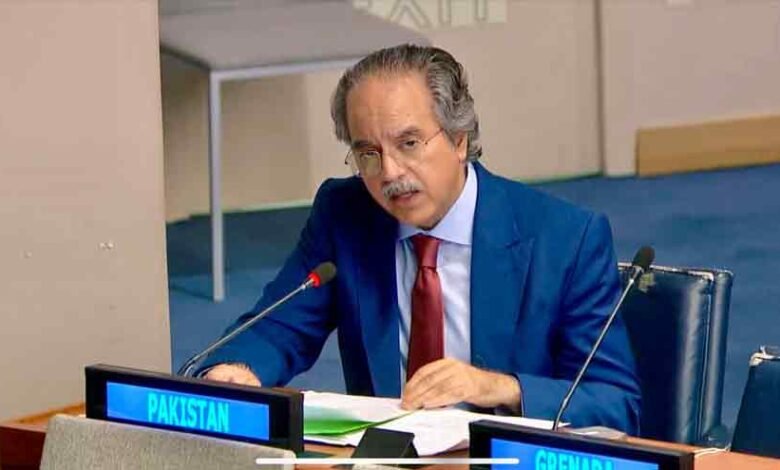
A senior Pakistani diplomat urged the UN Security Council to promptly classify the “foreign-funded” Balochistan Liberation Army (BLA) as a terrorist organization under its sanctions framework, instituted by Resolution 1267 in 1999, while reaffirming Pakistan’s commitment to combat and eliminate terrorism within its territory.
During a Council debate on ‘Threats to International Peace and Security Caused by Terrorist Acts,’ Ambassador Asim Iftikhar Ahmad, Pakistan’s permanent representative to the UN, stated that terrorist organizations such as Fitna al Khawarij (TTP) and Fitna al Hindustan (BLA) along with its Majeed Brigade have received a “new lease of life” following the Taliban’s takeover in Kabul.
The United States has designated BLA as a “foreign terrorist” group.
The Pakistani envoy said the 15-member Council, “We anticipate that the Council will promptly designate BLA under the 1267 sanctions regime, complying with the listing request presently under review.”
He stated that the international community must confront the modern terrorist threat with a “collective, comprehensive, and coordinated response,” which includes the equitable execution of the Global Counter Terrorism Strategy (GCTS).
Ambassador Asim Ahmad stated, “We must effectively address the terrorist threats emanating from Afghanistan,” highlighting that groups like BLA and TTP operate with virtual impunity from Afghan territory, receiving “active support from our eastern neighbor (implicitly referring to India),” and perpetrating “atrocious terrorist attacks within Pakistan.”
The Council’s Monitoring Team reported that the Afghan de facto authorities (DFA) facilitate a conducive environment for several terrorist organizations, including TTP; Al-Qaeda, ISIL-K (Da’esh) continues to operate with an external focus, and ETIM/TIP members traverse Afghanistan without restriction.
“These terrorist organizations present a menace not only to Pakistan but also to the entire region and beyond.” The Pakistani envoy stated, “Recent terrorist activity in Central Asia near the Afghan border has confirmed prior warnings. It is essential to prevent the billions of dollars’ worth of advanced weaponry and equipment abandoned by foreign forces in Afghanistan from being acquired by terrorists.”
This weekend, he noted that BLA asserted responsibility for a series of terrorist strikes in several sites within Balochistan Province, Pakistan, which led to the deaths of 48 innocent civilians, including 5 women and 3 children.
The Pakistani envoy stated, “Our valiant security forces neutralized 145 BLA terrorists during the effective counteraction.”
He stated that as a front-line state, Pakistan has incurred over 90,000 casualties and significant economic losses, referencing the nation’s efforts in destroying Al-Qaida and combating ISIL-Khorasan Province.
Ambassador Asim Ahmad emphasized the necessity for responsibility regarding external destabilizing entities that support, finance, and arm terrorist groups, especially their proxies in Afghanistan.
“There must be an absolute intolerance for state terrorism, exemplified by the blatant actions in Indian Illegally Occupied Jammu and Kashmir and other instances of foreign occupation,” he stated.
“Occupation and its associated repression cannot be disguised as counterterrorism to undermine the internationally recognized and UN-sanctioned legitimate struggles of peoples against foreign occupation and for their inalienable right to self-determination, in accordance with pertinent UN resolutions and international legitimacy.”
Ambassador Asim Ahmad urged the UN counter-terrorist framework and sanctions regimes to effectively meet contemporary problems and to serve as a fair, just, and comprehensive instrument for combating the worldwide menace of terrorism.
He noted that counter-terrorism policies have predominantly targeted adherents of a particular religion—Muslims. “It is essential to include new and emerging forms of terrorism, such as white supremacists, far-right extremists, violent nationalists, fascists, xenophobes, Islamophobes, and anti-Muslim groups, along with analogous ideologies globally.”
The Pakistani envoy stated, “Terrorism can only be vanquished through unity and collaboration, devoid of double standards or discrimination, by addressing its root causes and preventing its manipulation for politically motivated agendas.”
Initiating the discourse, Alexandre Zouev, Acting Under-Secretary-General of the United Nations Office of Counter-Terrorism, informed the Council that Da’esh and its associated terrorist factions persist in their adaptability and resilience despite ongoing counter-terrorism efforts, as he introduced the Secretary-General’s most recent biannual report regarding the threat ISIL/Da’esh poses to global peace and security.
Da’esh and its affiliates persist in their expansion across many regions of Africa, notably West Africa and the Sahel, with the Islamic State West Africa Province augmenting its influence in the Lake Chad Basin area, he stated. The group is operational in Iraq and Syria, while ISIL-Khorasan (ISIL-K) continues to represent a significant threat in Afghanistan and abroad, having asserted responsibility for the terrorist attack on 19 January at a restaurant in Kabul.
Zouev stated that artificial intelligence and other technologies are progressively utilized to facilitate radicalization and recruiting, especially among young and children, while commercial satellite communication systems are being leveraged for economical and secure communications.
The Secretary-General emphasized three critical priorities: the abysmal conditions in camps and detention facilities in north-east Syria, necessitating safe, voluntary, and dignified repatriation; the worsening security situation in certain regions of Africa, demanding political ownership and coordinated regional responses; and the imperative for comprehensive governmental and societal strategies rooted in the rule of law, human rights, and inclusive, nationally-driven prevention efforts.
Zouev stated, “The escalation of the threat from Da’esh and its affiliates, despite considerable national and international endeavors, highlights the necessity of maintaining global collaboration on counter-terrorism.” The ninth review of the United Nations Global Counter-Terrorism Strategy this year allows Member States to reaffirm pledges, evaluate progress since 2023, and confront emerging and developing threats.
Increasing Utilization of the Internet and Drones by Terrorists Provokes Concern. Natalia Gherman, Executive Director of the Counter-Terrorism Committee Executive Directorate, stated that in 2025, the Directorate performed assessment visits to Austria, Cameroon, Chad, Hungary, Malta, Norway, and Somalia, and is currently heading a visit to Tajikistan this week. “We collaborate closely with each Member State we visit” to offer customized support and ideas, she stated, further referencing a recent assembly of nations in Kenya focused on addressing the increasingly sophisticated use of the Internet by terrorists.
Ms. German stated that the Directorate has released its fourth Thematic Summary of Gaps, concentrating on Africa, and is aiding worldwide initiatives to impede the utilization of virtual assets and emerging financial technology for terrorist objectives. In accordance with its analytical duty to identify concerns, trends, and new developments, it released a report on risks to critical infrastructure in collaboration with the Organization for Security and Co-operation in Europe (OSCE). “The menace presented by the terrorist utilization of unmanned aerial systems has become a priority for numerous Member States,” she stated, further referencing the progressively sophisticated digital techniques employed to exploit youngsters.