Pakistan demands that disputes be resolved in order to preserve children’s futures and defend their right to an education.
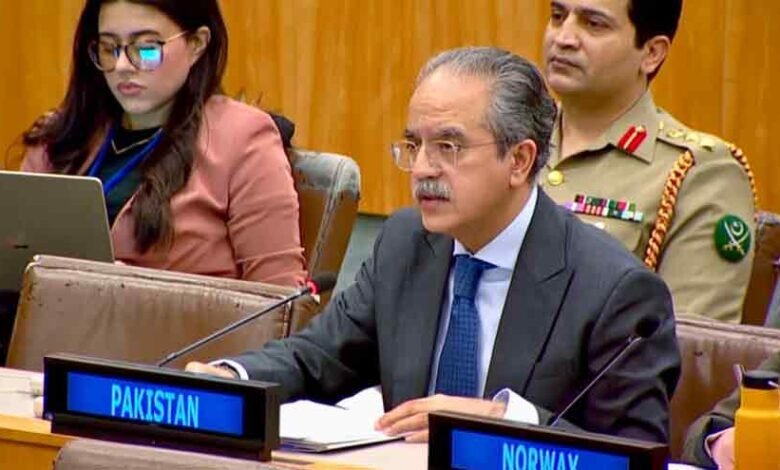
Pakistan has highlighted the dire situation in Palestine and Kashmir and told a historic session of the UN Security Council, chaired by US First Lady Melania Trump, that the best way to protect children and their right to education is to resolve lingering conflicts in line with the resolutions of the 15-member body, the UN Charter, and international law.
“Across conflict zones around the world, including situations of foreign occupation, notably Palestine and Jammu and Kashmir, millions of children are growing up amid rubble and chaos, rather than classrooms and calm,” stated Ambassador Asim Iftikhar Ahmad, Pakistan’s permanent representative to the UN, during the Council’s discussion on “Children, Technology and Education in Conflict.”
He noted that teachers have been relocated, internet networks have been disrupted, and schools have been demolished, damaged, or militarized.
According to the Pakistani envoy, “education systems, which were already precarious, have been driven to the verge of disintegration.”
Ambassador Asim Ahmad added that even when wars continue, it is our responsibility to make sure that no child’s future is destroyed by uncontrollable circumstances.
The United States, which is in charge of the president, called a meeting of the Security Council on Monday to discuss March.
As the Council focused on a long-standing but unaddressed issue affecting children in conflict areas, it convened under unprecedented circumstances: amid US-Israeli airstrikes against Iran, growing unrest in the Middle East, and repeated UN demands for moderation from all sides.
Mrs. Trump, who presided over the meeting, declared that the US “stands with all of the children throughout the world.”
For the first time, a first lady from any nation held the gavel throughout her speech.
“Pakistan is pleased to join this initiative,” Ambassador Asim Ahmad said in his remarks, welcoming the U.S. First Lady’s “Fostering the Future Together Initiative,” which aims to create a global coalition dedicated to improving children’s well-being through the promotion of education, innovation, and technology.
The Pakistani envoy went on to say, “The issue at hand is not just about innovation and technology—it is about protecting human dignity and making sure that conflict does not rob an entire generation of their future.”
He emphasized that the deterioration of education in war environments is not accidental, but rather frequently systematic, exacerbating trauma and sustaining conflict cycles.
“Prolonged interruptions to education have generational repercussions that go well beyond the immediate conflict.”
He asserted that education is a securing and stabilizing force rather than just a service. “When denied, children are more susceptible to recruitment, radicalization, trafficking, and exploitation.” Education cultivates optimism, critical thinking, and resilience when it is safeguarded.
According to the Pakistani ambassador, children who are uprooted or isolated in crisis situations can be reached by digital platforms and mobile learning tools.
In situations where physical classrooms are inaccessible, remote education can maintain continuity. Artificial intelligence is one of the emerging technologies that presents prospects for inclusive education and individualized learning.
However, he underlined that technology needs to be carefully regulated because unprotected access might be dangerous. “Children may be exposed to hate speech, exploitation, misinformation, surveillance, and abuse in digital environments.”
Ambassador Asim Ahmad called for bridging the digital divide in conflict-affected areas by investing in affordable connectivity, resilient infrastructure, and devices, giving special attention to girls and children with disabilities, incorporating child protection by design into all digital education programs, and enhancing cooperation and partnerships between member states, the UN, civil society, and the private sector.
“Transformative use of technology can be a shield and a bridge in complex conflict environments to enable the children’s right to safety, learning and development, and a catalyst for resilience, dignity, and lasting peace, which I understand from this discussion, is a shared objective, which merits our collective action and cooperation,” he continued.
The Under-Secretary-General for Political and Peacebuilding Affairs, Rosemary DiCarlo, had earlier stated that the discussion today is taking place at “a moment of exceptional relevance.”
In addition to the greatest number of civilian deaths in decades, the world is currently seeing more armed conflicts than it has since World War II.
She remarked, “Children are among those most severely affected when conflicts erupt.” This statement was made in light of the fact that, due to ongoing military actions in the region, schools in Israel, the United Arab Emirates, Qatar, Bahrain, and Oman have closed and switched to remote learning during the past two days.
Ms. DiCarlo referenced Iranian sources that said “possibly dozens” of children had died as a result of a strike that struck a Minab primary school.
She emphasized that “one in five children worldwide are living in or escaping a conflict zone.” “There are 473 million children in total.”