The Houthis of Yemen claim responsibility for the missile assault on Israel.
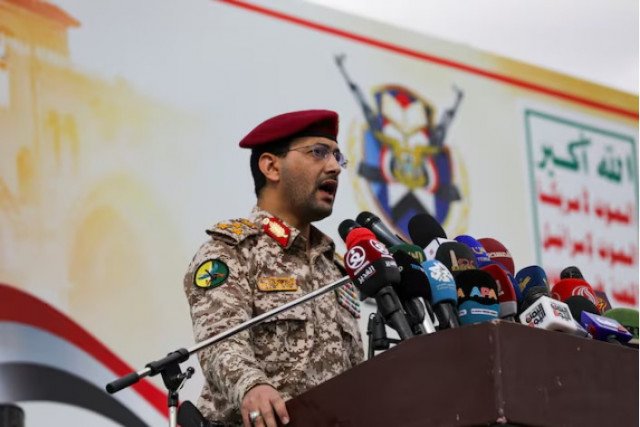
The Houthi rebels of Yemen have asserted responsibility for their inaugural missile strike on Israel since the commencement of the US-Israel conflict with Iran.
Brigadier-General Yahya Saree, the military spokesperson for the Houthis, made the assertion in a statement broadcast on Saturday by Al-Masirah satellite television, as reported by Al Jazeera.
The troops previously indicated that they were prepared for direct military engagement should assaults on Iran and its proxies persist.
The Israeli military reported intercepting a missile near Beer Sheba, in southern occupied Palestine, as sirens activated in the vicinity, including near the Israeli regime’s primary nuclear research facility, for the third time overnight from Friday to Saturday. Al Jazeera reports that no injuries have been documented.
U.S. airbase in Saudi Arabia assaulted
Approximately 10 US service men sustained injuries in an Iranian assault on Prince Sultan Air Base in Saudi Arabia on Saturday, as reported by a US official to CNN.
At least two of the injured sustained non-life-threatening shrapnel wounds, while others were described as “impacted,” although the specifics of their injuries were not immediately discernible, according to another US official.
A refueling aircraft sustained damage, according to the initial source.
As reported by Al Jazeera, the Islamic Resistance in Iraq, an assemblage of Iran-supported militant organizations, assaulted “multiple” air bases and an airport in Jordan, as per the Iraqi news source Sabereen.
The assault occurs as Israel announced its offensive against Tehran, asserting a defense against missiles launched from Iran on Saturday, following Secretary of State Marco Rubio’s statement that the US anticipated concluding military operations within weeks rather than months.
A US official informed Reuters on Friday that Iranian retaliation against a Saudi Arabian air base resulted in injuries to 12 US military personnel, two of whom were critically wounded, as drones and missiles persistently targeted US installations throughout the Gulf.
One month following the initiation of strikes by the US and Israel on Iran, the conflict has escalated throughout the Middle East, resulting in the deaths of thousands of people, predominantly in Iran and Lebanon, and leading to unprecedented disruptions in energy supplies, adversely impacting the global economy and exacerbating inflationary concerns.
Kuwait International Airport was subjected to several drone strikes that inflicted considerable damage on its radar system, although there were no casualties, according to the state news outlet KUNA, referencing the nation’s Civil Aviation Authority.
According to Reuters, Oman’s government said that a worker sustained injuries in a drone strike at Salalah port, while a crane incurred minor damage.
According to Press TV, an Israeli strike on Isfahan in central Iran on Friday resulted in the deaths of 26 individuals, comprising seven children and seven women.
Russian Foreign Minister Sergei Lavrov and Iranian Foreign Minister Abbas Araghchi have deliberated on the potential for a diplomatic resolution to the Iran conflict, as reported by Lavrov’s ministry, according to Al Arabiya.
Drop Site News reported that Beirut’s southern suburbs were again targeted on Saturday. Israel is advancing its ground assault from three distinct fronts; nevertheless, Al Jazeera claims it is encountering “fierce resistance” from Hezbollah combatants.
The Turkish Foreign Minister addresses the STRATCOM summit.
Turkish Foreign Minister Hakan Fidan denounces Israeli aggression towards Iran, asserting that illegitimate attacks on Iran have “pushed the region to the brink of wider war, instigated by incessant Israeli escalation,” as reported by TRT World.He stated that we dismiss any possibility that entangles regional governments in catastrophic conflict.
He stated that although this is Israel’s war of choice, the global community is enduring the repercussions, and Iran’s retaliation against US facilities in Gulf nations merely exacerbates the regional crisis.We must all accept the security responsibilities of our region, as we collectively endure the consequences of conflict and instability,” he stated.Our region must no longer be susceptible to external intervention.
Thai tankers ensure secure transit in the Strait of Hormuz
Thai Prime Minister Anutin Charnvirakul announced at a news conference, as reported by AFP, that an agreement has been established to permit the safe transit of Thai oil tankers via the Strait of Hormuz.
Trump interrogates the rationale for the United States’ involvement with NATO.
Israel reported striking targets throughout Iran’s capital and indicated the identification of a missile launched from Yemen. The Iran-aligned Houthis in Yemen, formerly known for disrupting shipping through missile strikes, have remained inactive in the Iran conflict.
On Friday, the Houthis declared their readiness to engage militarily under specific conditions, such as the involvement of new partners alongside the US and Israel in the conflict, or if the Red Sea were utilized to initiate assaults on Iran.
Rubio informed reporters following a meeting with Group of Seven counterparts in France that Washington was “on or ahead of schedule in that operation and anticipates concluding it in a matter of weeks, not months.”
Europeans will confront Rubio over Russian assistance for Iran at G7 summit
The conflict has created a rift between the US and its longstanding allies, who have remained passive. President Donald Trump stated that this deficiency of support had ramifications for NATO, the West’s paramount alliance.We would have consistently supported them; yet, given their behavior, it appears we are no longer obligated to do so, are we? Trump addressed an investment forum in Miami on Friday. Why should we support them if they do not support us? They were absent for us.
The charter of the North Atlantic Treaty Organisation, historically led by the US, stipulates that an assault on one member is an assault on all, necessitating mutual support among members.
Rubio stated that European and Asian nations benefiting from trade via the Strait of Hormuz, a critical chokepoint predominantly obstructed by Iran, ought to participate in initiatives to ensure unimpeded transit.
He stated that the US could accomplish its objectives without ground forces, however he recognized the deployment of soldiers to the region “to provide the president with maximum flexibility and opportunity to modify contingencies, should they arise.”
Increased strikes as Trump discusses negotiations
Washington has deployed two contingents of thousands of Marines to the region, with the first expected to arrive shortly by a massive amphibious assault ship. The Pentagon is anticipated to deploy thousands of special airborne troops.
The deployments have elicited apprehensions that the conflict may escalate into an extended ground engagement.
Stock markets plummeted significantly on Friday, while the Brent crude oil benchmark LCOc1 exceeded $112, having increased almost 50% since the onset of the war.
Further information: Late sell-off causes PSX to decline by 1,200 points
In the United States, where Trump faces political susceptibility due to escalating fuel prices, diesel in California reached a record average of $7.17 per gallon, according to the American Automobile Association.
Trump has shown a desire to conclude the unpopular war, highlighting this week what he termed constructive negotiations aiming at a diplomatic resolution, despite Tehran’s continual claims that no such discussions have commenced. On Thursday, Trump prolonged the deadline by 10 days for Iran to reopen the Strait of Hormuz or confront assaults on its civilian energy infrastructure.
According to Iranian media reports on Saturday, a US-Israeli assault on a residential unit in Zanjan, a city in northwestern Iran, resulted in the deaths of at least five individuals and injuries to seven more. The Iran University of Science and Technology in Tehran was also impacted.
Iranian Foreign Minister Abbas Araqchi stated on X that Israel, in conjunction with the United States, had targeted two steel mills and a power plant. “The attack undermines the President’s prolonged deadline for diplomatic efforts.” Araqchi stated on Friday that Iran will impose a significant cost for Israeli transgressions, utilizing an acronym for the President of the United States.
On Saturday, Israel’s military announced the detection of inbound missiles from Iran, while Syrian state television reported explosions over the capital Damascus resulting from Israeli interceptions of these missiles.
Early on Saturday, the United Arab Emirates and Bahrain reported missile assaults.
Iran pledges to impose significant consequences.
Iran’s Foreign Minister Abbas Araghchi has cautioned that Tehran will impose a “heavy price” for what he characterized as Israeli assaults on critical industrial and nuclear infrastructure, as tensions between the two parties escalated.
In a social media post, Araghchi stated that Israel had targeted two of Iran’s largest steel mills, a power plant, and civilian nuclear facilities, noting that Israel asserted the operation was conducted in collaboration with the United States.
The Revolutionary Guards of Iran reiterated the threat, advising employees at industrial facilities associated with the United States or Israel to “vacate their workplaces immediately,” indicating the potential for additional punitive actions.
Earlier today, US-Israeli raids targeted two Iranian nuclear facilities: the Khondab heavy water complex and a uranium processing plant in Ardakan, as well as two significant steel plants. Israeli military verified the assaults, although Iranian officials stated that there had been no release of radioactivity.
The Israeli military reported that Iran retaliated by launching missiles, resulting in one fatality in Tel Aviv and at least four further injuries. Air raid sirens were activated in Jerusalem, and explosions were recorded in proximity to Jericho in the occupied West Bank.