As the Iran War intensifies, President Zardari and Prime Minister Shehbaz have important discussions on national security.
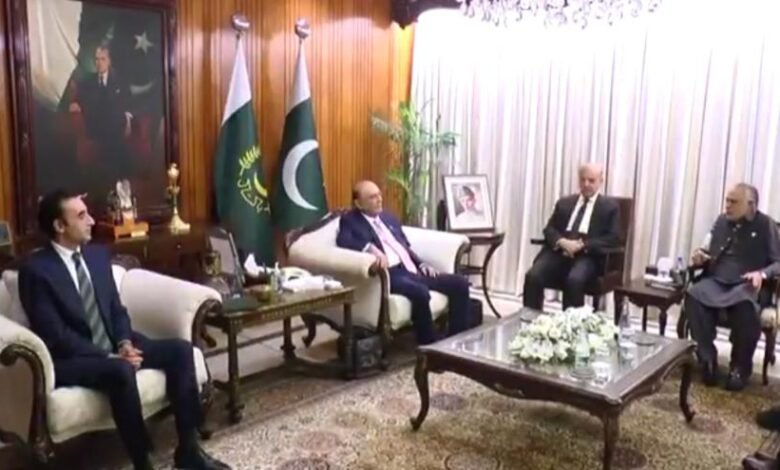
At a high-level meeting in Islamabad on Monday, Prime Minister Shehbaz Sharif and President Asif Ali Zardari discussed the nation’s national security situation, with an emphasis on the quickly changing regional scene in light of the continuing US-Israel battle involving Iran.
The president was summoned by the prime minister, and the two leaders had in-depth discussions about Pakistan’s new problems, such as economic strains, energy issues, and security threats associated with the larger Middle East crisis.
Ishaq Dar, the deputy prime minister and foreign minister, Bilawal Bhutto Zardari, the chairman of the Pakistan Peoples Party, Mohsin Naqvi, the interior minister, and Lieutenant General Asim Malik, the director general of inter-services intelligence and national security adviser, were present at the meeting.
The President’s Secretariat reports that participants discussed the implications of regional developments for Pakistan and shared opinions on the overall national security situation. A number of urgent topics were discussed, such as how geopolitical conflicts affect energy supplies and economic stability.
In order to effectively address the growing problems, the leadership emphasized the necessity of a unified national strategy supported by improved institutional cooperation. In order to manage both short-term and long-term risks, emphasis was placed on achieving policy congruence among important state institutions.
The meeting took place one day after the foreign ministers of Pakistan, Saudi Arabia, Turkey, and Egypt met in Islamabad to discuss measures to defuse the escalating conflict. Pakistan’s increasing position as a mediator in attempts to reduce tensions in the Middle East is reflected in the diplomatic interaction.
Participating in the discussions were foreign ministers Prince Faisal bin Farhan of Saudi Arabia, Hakan Fidan of Turkiye, and Badr Abdelatty of Egypt. The goal of the negotiations was to secure an early and long-lasting resolution to the war. The visiting dignitaries also had private conversations with PM Shehbaz after the meeting.
As the conflict rages on, Pakistan has increasingly positioned itself as a diplomatic go-between for Iran and the United States, sending messages between the two sides. With significant ramifications for regional stability, the war, which started on February 28, has now reached its second month.
Global energy markets have also been affected by the crisis, especially through the Strait of Hormuz, which is a vital route for the transportation of gas and oil. For nations like Pakistan that rely significantly on energy imports, the ensuing unpredictability has increased economic pressures.
According to the Foreign Office, Deputy Prime Minister Ishaq Dar will travel to China on March 31 to have in-depth talks about regional trends as well as bilateral and international matters of shared interest.
The most recent meeting comes after Prime Minister Shehbaz Sharif, Chief of Defence Forces and Chief of Army Staff Field Marshal Asim Munir, and other high-ranking officials attended a recent high-level meeting presided over by President Zardari. With an emphasis on austerity measures, fuel conservation, and public relief activities, that meeting examined economic and energy concerns in light of possible supply disruptions.