After unsuccessful negotiations with Iran in Pakistan, a US delegation departs
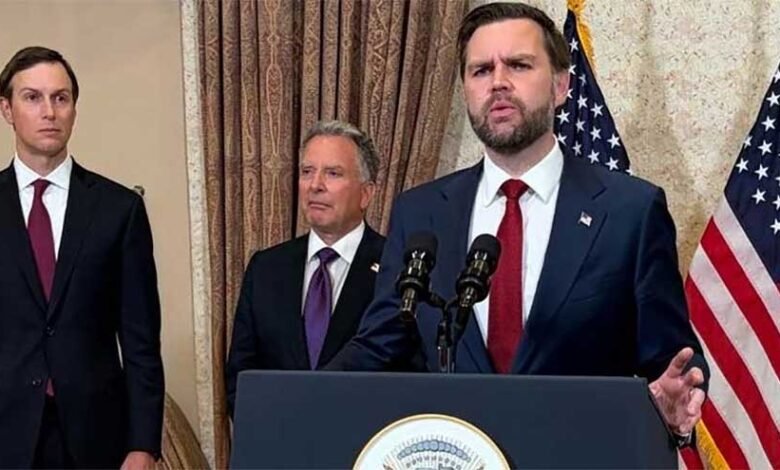
After lengthy negotiations in Pakistan, US Vice President JD Vance claims that no agreement was achieved with Iran.
He stated that Iran will not pledge not to pursue nuclear weapons.
Vance claims he arrived “in good faith,” but the vice president is now departing Pakistan and says the US wants to see a “fundamental commitment of will” from Iran to refrain from developing nuclear weapons.
Iran’s foreign ministry described the negotiations as “intensive” and urged Washington to abstain from “excessive demands and unlawful requests.”
Iran’s foreign ministry claims that the lengthy discussions addressed topics like Tehran’s nuclear program and the Strait of Hormuz.
Following crucial peace negotiations between US and Iranian officials in Islamabad, US Vice-President JD Vance was speaking.
The Strait of Hormuz is reportedly a major area of contention in Iran and the US’s historic face-to-face negotiations, which are currently underway in Islamabad, according to foreign media.
As hours-long deliberations regarding the conflict with Iran continue into Sunday, a White House official said trilateral talks are taking place in Pakistan.
The talks have been generally constructive, according to international media that cited Pakistani sources, but there is still a deadlock over sovereignty of the Strait of Hormuz, a crucial waterway where the US claimed to have started mine-clearing operations on Saturday.
In Islamabad, a US group headed by Vice President JD Vance had direct meetings with Iranian officials. This was a momentous occasion for the two nations, who had usually had high-level discussions through middlemen.
IRAN: HORMUZ’S STRAIT, NUCLEAR ISSUE DISCUSSED
According to Esmaeil Baqaei, a spokesperson for Iran’s Foreign Ministry, “intensive negotiations” between the United States and Iran about Tehran’s nuclear program and the Strait of Hormuz proceeded unabated into the early hours of the morning in Islamabad.
At approximately 5.30 a.m. local time, Baqaei stated on X, “Discussions were held on various dimensions of the main negotiation topics, including the Strait of Hormuz, the nuclear issue, war reparations, lifting of sanctions, and the complete end to the war against Iran and in the region.”
According to Baqaei, the negotiations’ success depended on the other side’s “seriousness and good faith, refraining from excessive demands and unlawful requests, and the acceptance of Iran’s legitimate rights and interests.”
GOOD FAITH IS THE KEY TO SUCCESS: IRAN
“The success of this diplomatic process depends on the opposing side’s seriousness and good faith, refraining from excessive demands and unlawful requests, and the acceptance of Iran’s legitimate rights and interests,” stated Baghaei, an Iranian official.
A LONG AND BUSY DAY IN ISLAMABAD
Iran’s Ministry of Foreign Affairs spokesperson has released a statement regarding the current negotiations with the United States in the capital of Pakistan.
Esmaeil Baghaei said on X, “The Islamic Republic of Iran delegation in Islamabad had a busy and long day today.”
“Numerous messages and texts have been exchanged between the two sides, and the intensive negotiations that started on Saturday morning with Pakistan’s benevolent efforts and mediation have continued uninterrupted until now,” he stated.
China will face significant issues: Trump
China would face “big problems” if it transports weapons to Iran, according to President Donald Trump.
When a CNN reporter questioned him about US intelligence showing Beijing is getting ready to supply weapons to Iran, he implied that Beijing would suffer repercussions if it did.
As he departed the White House for Florida, he remarked, “If China does that, China will have big problems, OK?”
Trump is scheduled to meet with Chinese leader Xi Jinping early next month, but he did not specify if he has spoken to him.
According to three sources familiar with recent intelligence assessments, the media initially reported earlier on Saturday that US data suggested China is getting ready to transfer new air defence systems to Iran within the next several weeks.
The intelligence emphasises how Iran might be taking advantage of the ceasefire to restock specific weaponry systems with the assistance of important international allies.
Members of the Iranian military arrive in Pakistan
According to international media, senior personnel from Iran’s Islamic Revolutionary Guard Corps (IRGC), air force, navy, and even the Quds force—an IRGC organization in charge of overseas operations—arrived in Pakistan.
The media report claims that the newcomers are helping the Iranian delegation with logistics and support. Among them, top IRGC employees are supposed to offer “consultation.”