Top military brass warn of severe action against May 9-style unrest
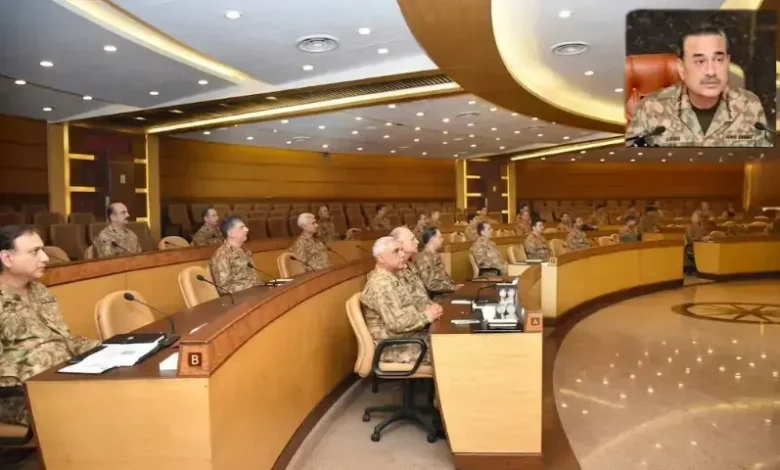
Field Marshal Syed Asim Munir, Chief of Army Staff and Chief of Defense Forces (COAS & CDF) of Pakistan chaired the 277th Corps Commanders’ Conference at General Headquarters (GHQ) in Rawalpindi where military leaders reviewed the current security environment, counter-terrorism operations and operational preparedness.
The forum began with Fateha for the Shuhada of the Armed Forces, law enforcement agencies and civil society who sacrificed their lives in service of the country. Participants paid tribute to their sacrifices and commemorated martyrs of Pakistan.
The conference reiterated the need for a high level of readiness in the face of the changing security scenario. It also highlighted Pakistan’s stated right to self-defense and action against terrorists emanating from Afghanistan.
Security review
The forum blamed the Taliban leadership for the repercussions of facilitating terrorism, saying it was doing it on behalf of India. The remarks came as the military leadership evaluated security problems and reiterated its resolve to tackle threats to Pakistan’s national security.
The participants complimented the continued intelligence based counter-terrorism activities of law enforcement agencies. However, the summit emphasized that operational measures need to be supplemented with non-kinetic initiatives to address the root causes of militancy and insecurity.
These include people-centric government at the grassroots level, strategic engagement with the public, deconstructing the terror-crime nexus purportedly working under the patronage of vested interests and boosting police capacities.
The meeting underscored that these efforts should be in line with the National Action Plan and Vision Azm-e-Istehkam which were referred to as frameworks for tackling the country’s security concerns.
Internal stability
The commanders stressed the need for domestic stability and restated their position against efforts to foment disturbance. The forum added that no matter what pretext any attempt to create a situation similar to that of May 9 will be handled with resolute force and action within the framework of the law, without hesitation or discrimination.
The reference to May 9 is about the turmoil which broke out in 2023 after the imprisonment of former prime minister Imran Khan, where military installations and other public property were assaulted at various places. The military leadership stressed its determination to respond to efforts to destabilize the country.
The conference also underscored the need to sustain counter-terrorism efforts while improving governance, public participation and law enforcement capacity to address security issues on a number of fronts.
Regional Links
The Makkah Joint Defense Agreement comprising Pakistan, Saudi Arabia and Turkiye was welcomed by the forum. It said it was a development contributing to long-standing strategic cooperation and collective defense connections among the countries.
Participants also strongly criticized the Houthi attacks against Saudi Arabia and voiced solidarity with the Kingdom. The summit reaffirmed Pakistan’s commitment to protect the security and sanctity of the Haramain Sharifain, the two holy mosques in Makkah and Madinah.
The military leadership underlined the country’s stance on the Kashmir issue regarding Indian Illegally Occupied Jammu and Kashmir (IIOJK). It also reiterated its support for the resolution of the dispute in accordance with the relevant United Nations Security Council resolutions and the aspirations of the people of Kashmir.
The debates highlighted the forum’s focus on Pakistan’s security priorities, its regional partnerships and long-standing diplomatic views.
combat-readiness
In his concluding remarks, Field Marshal Asim Munir lauded the professional acumen and operational readiness of military forces. He called on the commanders to keep the pace of intelligence-led operations and to continue to enhance the combat power of the Armed Forces.
The guidance required increased use of current technology, increased training, and better integration across many operational domains. The focus on multi-domain integration demonstrated the necessity to build joint capabilities to address changing security problems.
Munir said he firmly believed that the Armed Forces, with the backing of the public were completely prepared to defend Pakistan’s sovereignty, territorial integrity and national security.