Dar condemns India’s weaponization of water, says Indus Waters Treaty remains in force
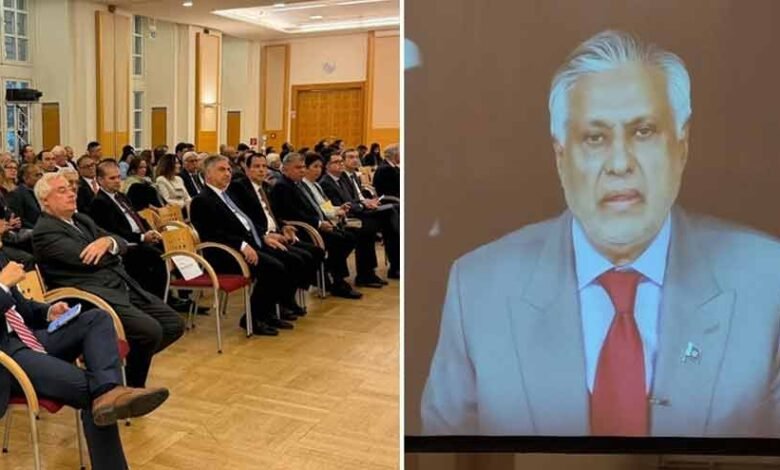
Deputy Prime Minister and Foreign Minister, Senator Mohammad Ishaq Dar, on Tuesday criticized India for using water as a tool of pressure and stressed that the Indus Waters Treaty (IWT) is still fully active.He pointed out that India’s decision to put the treaty on hold has no legal foundation.
Speaking at the “International Water Symposium” in Vienna via a video message, Senator Dar said that rivers shared between countries should support peace and teamwork, not force and control.
The symposium was organized by the Pakistan Embassy in Austria, working with the Diplomatic Academy of Vienna.
It brought together diplomats, scholars, and experts to talk about water safety and international teamwork, with a special session on managing rivers across borders, water rights, and international law.A news release from the DPM’s office shared this.
Senator Dar mentioned that India placed the treaty on hold in April 2025, even though the treaty itself doesn’t allow either side to stop or suspend it.
He highlighted the unanimous ruling from the Court of Arbitration on August 31, 2026, which reviewed India’s claims, such as a serious violation, major changes, war, and countermeasures.The court found none of these justified stopping or ending the treaty.
He stated the court clearly confirmed the treaty is still fully in effect and that India must follow its rules, especially those about designing and running hydroelectric projects on the Western Rivers.
He described this as a strong reaffirmation of the legal principle that agreements must be honored.
Senator Dar also noted that on the same day the court issued an order about the Ratle Hydro-Electric Plant.
It limited the completion of some parts of the project until 90 days after the Neutral Expert’s final decision and required India to share details on the project’s schedule.
He said that even though these court rulings support Pakistan’s position and reject India’s actions, India continues its firm stance and illegal actions toward the treaty.
He stressed the importance of the Indus system, which supports the lives and work of over 250 million Pakistanis, helping in farming, food supply, electricity, and economic growth.
He said for Pakistan, water safety is closely linked to food, economic, and national security.
He warned that using water to pressure such a large population would cause serious human, economic, and security issues.
He also said India’s actions could set a dangerous example for other shared river systems where millions rely on following international agreements.
Senator Dar said Pakistan has always tried to solve differences through talks, diplomacy, and the treaty’s dispute solutions.
Pakistan is also taking part in the Neutral Expert process, which is run by the Vienna Office of the Permanent Court of Arbitration at the Hofburg Palace.It is working well with the process.
He outlined three main points: the treaty must be respected and followed properly, its obligations can’t be tied to political ties or one-sided choices, and all issues and disputes should be resolved through the treaty’s own methods, and those decisions must be followed.
Both countries should improve technical work, sharing data and being open.
He emphasized the role of the international community in upholding international law and teamwork based on treaties.
He said that while the world order based on international law faces challenges, the community should strengthen treaty-based cooperation rather than allow it to weaken.
He repeated Pakistan’s position: “Our choice is always cooperation, not pressure, and dialogue, not conflict, and the rule of law, not unilateral action.”
He also made it clear that there should be no confusion about Pakistan’s determination to protect its rightful water rights under the treaty and international law.
He warned that any attempt to take away water that is rightfully Pakistan’s would have serious effects on regional peace and safety.
The deputy prime minister wished the symposium productive discussions and hoped it would help build stronger international cooperation on water management.