According to Pakistan, there is rising backing for its desire to hold war negotiations in the Middle East.
To bring an end to the conflict between the United States and Iran, Pakistan announced on Sunday that it was prepared to act as a mediator and organize “meaningful talks” between the two countries. Pakistan also highlighted the rising support it is receiving for its efforts to promote peace, particularly from the United Nations and China.
At this point, the government in Islamabad has emerged as a significant facilitator, acting as a conduit for communication between the two sides in an effort to prevent the crisis from becoming more severe.
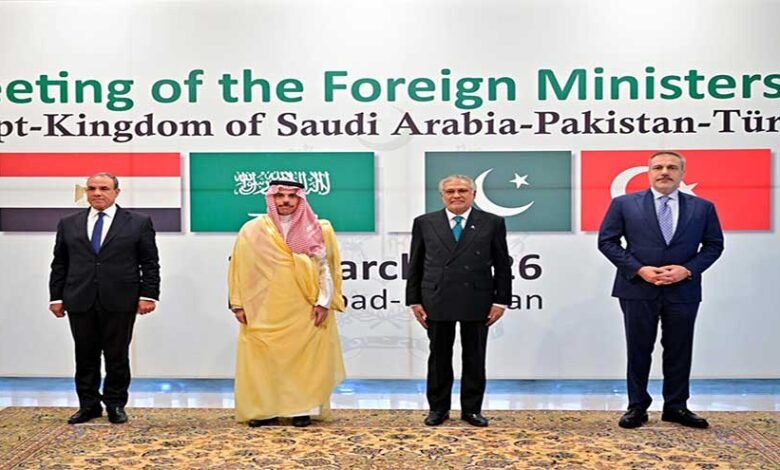
On Sunday, Pakistan’s Foreign Minister Ishaq Dar visited his colleagues from Saudi Arabia, Egypt, and Turkey for several hours in the capital city of Pakistan. Concerns were high on the impact of the battle, which included the stifling of marine commerce through the strategically important Strait of Hormuz.
In a statement that was shown on television, Dar, who is also the deputy prime minister of Pakistan, stated that the guests “expressed their full support” for the possibility of discussions between the United States and Iran taking place in Islamabad.He went on to say that the foreign ministers urged for conversation and diplomacy as the only possible road to prevent crises and to promote peace and harmony in the area.
Pakistan is attempting to capitalize on its long-standing connections with Tehran and its close relations in the Gulf region. Additionally, Pakistan is attempting to capitalize on the personal rapport that Prime Minister Shehbaz Sharif and Field Marshal Asim Munir, the powerful army chief of Pakistan, have established with President Donald Trump of the United States.
According to the statement made by the foreign minister, Dar and Sharif have been “actively engaged” with the administration of the United States of America. They have taken part in many phone discussions with senior government ministers in Iran, such as President Masoud Pezeshkian and Foreign Minister Abbas Araghchi.According to him, “Pakistan is very happy that both Iran and the United States have expressed their confidence in Pakistan to facilitate the talks.” This is the backdrop in which Pakistan is quite happy.In the coming days, Pakistan will have the honor of hosting and facilitating substantive talks between the two sides in an effort to reach a comprehensive and long-lasting resolution to the current conflict.
Both his Chinese counterpart Wang Yi and Antonio Guterres, the Secretary-General of the United Nations, have been contacted by Dar. He went on to say that they “fully support” Pakistan’s efforts to achieve peace, just like other nations all across the world do.PLANNING OF EVENTS’
Cairo stated that the conversations that took place on Sunday were held under strict security and did not include any representatives from the United States, Israel, or Iran. The discussions focused on measures to avoid the crisis from expanding further and to urge “a negotiations track” between Tehran and Washington in order to prevent the area from “slipping into a state of complete chaos.”
As well as meeting with Munir, the three visiting ministers, Badr Abdelatty from Egypt, Hakan Fidan from Turkey, and Faisal bin Farhan from Saudi Arabia, also met with Sharif.
It has been reported by Iran’s Tasnim news agency that Tehran has not admitted to holding official negotiations with Washington, but that it has passed a response to Trump’s 15-point plan to end the war through Islamabad.
Foreign Minister Johann Wadephul of Germany stated on Friday that he anticipated a direct meeting between the United States and Iran to take place in Pakistan “very soon.”
However, Shuja Nawaz, the founder and director of the South Asia Center at the Atlantic Council, stated that Pakistan had undertaken a “challenging task” in its efforts to bring Washington and Tehran to the table.According to Nawaz, author of “The Battle for Pakistan: The Bitter US Friendship and a Tough Neighbourhood,” who spoke with AFP, “it could only do this with Saudi blessing.””The actual issue for Pakistan is to bring together a single individual in the White House who is constantly changing his views and an Iranian administration that is deciding whether to fight a lengthy war or put an end to its economy being more wrecked. This is the true challenge that Pakistan faces.Any decision that President Trump makes to declare victory and bring an end to a conflict that is damaging his popularity at home will be made more difficult by the independent decision-making process of Israel. When it comes to the United States and Iran, Pakistan has very little influence, but it has none with Israel.Is it going to continue to be an event planner only?
Considering that Pakistan is dependent on oil and gas supplies through the Strait of Hormuz, the country’s measures make perfect economic sense. It is possible that continued disruptions to shipping could make fuel shortages worse, which would result in higher prices and the need for additional austerity measures.
Towards the end of Saturday, Dar reported that Iran has granted permission for twenty additional Pakistani-flagged vessels to transit through the Strait. This equates to two ships every day.