Despite strike worries, Iran-US discussions are anticipated on Thursday.
Despite a significant increase in American military power in the Middle East, Iranian officials expressed optimism that negotiations with US negotiators would move closer to a settlement to prevent new hostilities when they resumed on Thursday.
After Washington’s envoy Steve Witkoff openly questioned why Tehran had not yet “capitulated,” Iran’s Foreign Minister Abbas Araghchi told CBS News on Sunday that the terms of a potential agreement were being drafted ahead of the reopened negotiations on Tehran’s nuclear program.
The regional mediator Oman’s foreign minister, Badr Albusaidi, stated that negotiations would restart in Geneva on Thursday “with a positive push to go the extra mile towards finalizing the deal.”
Since a widespread protest movement in Iran triggered a crackdown that rights groups claim killed thousands, the United States has increased its threats of military action. Iranian students staged opposing and pro-government demonstrations on Sunday, with those who opposed the clerical leadership facing possible incarceration or worse if they were discovered.Araghchi made a reference to US interests in the area as possible targets when he stated, “We have every right to defend ourselves if the US attacks us.”
However, he asserted that “there is a good chance to have a diplomatic solution”
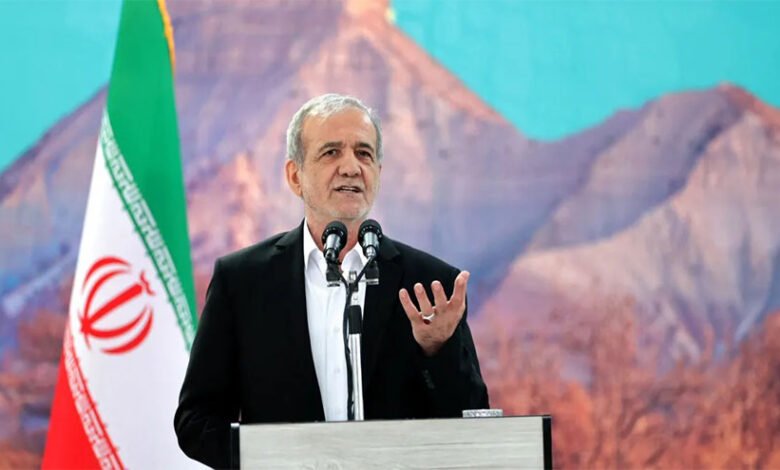
Iranian President Masoud Pezeshkian also stated that earlier discussions “yielded encouraging signals” in a social media post.
Iran announced that it was working on a draft proposal for an agreement that would prevent military action following a recent round of talks in Geneva.Araghchi told CBS, “I think we can work on those elements, prepare a good text, and come to a quick deal when we meet, probably this Thursday in Geneva again.”
An unnamed senior US official was quoted by Axios as saying that Washington was prepared to meet again later this week “to start detailed negotiations” if Iran delivered their plan within the next 48 hours.
In order to support its threats of military action, the US has recently dispatched two aircraft carriers, as well as other ships and jets, to the Middle East and strengthened its air defenses there.
In an interview with Fox News on Saturday, Witkoff, the chief Middle East negotiator for US President Donald Trump, stated that the president was wondering why Iran had not yet bowed to pressure.He wants to know why they haven’t. “Why haven’t they capitulated?” he asked, avoiding the word “capitulated.”Why haven’t they approached us and stated, “Here is what we’re willing to do, since we claim we don’t want a weapon?”
Although Tehran has long maintained that it has the right to enrich uranium for civilian uses, Western nations believe that Iran’s nuclear program is intended to create a bomb.
Araghchi stated on Sunday that Iran had “every right to decide for ourselves” about uranium enrichment.
ANXIETY FOR WAR
Israel’s bombing campaign against the Islamic republic disrupted a previous round of diplomacy last year.
The United States briefly joined the 12-day fight in June by attacking Iran’s nuclear facilities.
Iranians’ concerns for a fresh confrontation have increased in spite of the recent negotiations mediated by Oman.Even while taking medication, I have trouble sleeping at night,” Tehran resident Hamid told AFP.
According to 46-year-old IT expert Mina Ahmadvand, “war between Iran and the US as well as Israel is inevitable at this stage.”Although I oppose war, one should not play with the reality on the ground.
A number of foreign nations, including Sweden, Serbia, Poland, and Australia, have called on their citizens to leave Iran due to the worries.
TESTING
Iran has already stated that it is in its best interests to reach a settlement as soon as possible if it means removing the sanctions that have crippled its economy and fueled protests against the high cost of living towards the end of last year.
According to rights groups, those protests swiftly turned into widespread anti-government rallies that constituted one of the biggest threats to the Islamic republic’s leadership in recent memory. As a result, authorities launched a brutal crackdown that claimed thousands of lives.
After similar protests the previous day, Iranian students gathered on Sunday for new pro- and anti-government rallies honoring those dead.
The Islamic revolution of 1979 overthrew the shah, and protesters chanted “death to the shah” while others waved the flag of Iran’s overthrown monarchy, according to local and diasporic media agencies.
After originally supporting the demonstrators and vowing to step in during the crackdown on their side, Trump quickly turned his threats to Iran’s nuclear program.
Several Kurdish-Iranian parties based in Iraq said Sunday they were creating a political coalition to unify against Iran’s Islamic regime, expressing sympathy for the protesters.
According to a joint statement, “the struggle to overthrow the Islamic republic of Iran, and to achieve self-determination for the Kurds” are the alliance’s primary objectives.