Gazans want the “lifeline” Rafah crossing to reopen.
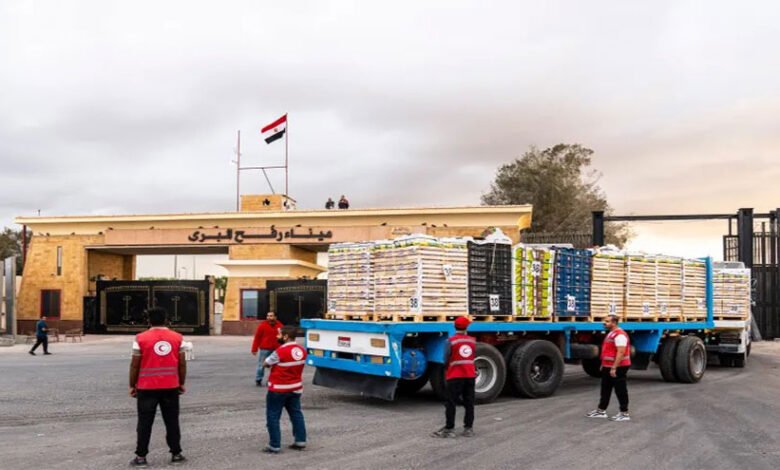
Residents of the war-torn region are either hoping to evacuate or reconnect with family members as the crucial Rafah border crossing in Gaza is set to reopen soon.
The Rafah crossing, which connects Gaza and Egypt, is a crucial access point for both people and products and the Palestinian territory’s only external entry point that does not go to Israel.
With the exception of a temporary reopening in early 2025, it has been shuttered since Israeli forces took over in May 2024, and other attempts to reopen have not succeeded.
Rafah is anticipated to reopen for pedestrians after a ceasefire mediated by the US went into effect in October. According to reports, visiting US envoys pressured Israeli officials to restore the crossing.
For me, opening the Rafah crossing is a step toward opening the door to life. Mahmud al-Natour, 48, of Gaza City, stated, “I haven’t seen my wife and children for two years since they left at the beginning of the war and I was prevented from traveling.”
“My children are growing up far away from me, and the years are passing by as if we are cut off from the world and life itself,” he stated to AFP.
The 48-year-old Randa Samih referred to the crossing as “the lifeline of Gaza,” but she is concerned about her ability to escape.
In order to receive care for her back injury, which she believes may not be severe enough to warrant her release, she had asked for a departure permission.
“There are tens of thousands of injuries in Gaza, most of them more serious than mine,” she stated.
“We’ll die or our health will decline before we get to travel.”
“LIMITED REOPENING”
Before Hamas’s strike started the conflict, Israel had already imposed a siege on Gaza, a small region bounded by Egypt, Israel, and the Mediterranean Sea.
In an attack on October 7, 2023, Palestinian militants killed 1,221 persons, mostly civilians, and captured 251 hostages.
According to the United Nations-reliable health ministry numbers in Hamas-run Gaza, Israel’s retaliatory operation has killed at least 71,662 Palestinians. Although the ministry’s statistics indicates that over half of the fatalities were women and children, it does not specify the proportion of fighters among the dead.
The National Committee for the Administration of Gaza (NCAG), established as a component of the ceasefire agreement, is led by Ali Shaath. Rafah will reopen in both directions, he declared last week.
The “limited reopening” of the crossing will only permit pedestrian traffic, according to Israel, until the remains of the final hostage, Ran Gvili, have been recovered.
Later on Monday, his remains were returned to Israel.
“Estimates indicate that the Rafah crossing could be opened in both directions by the end of this week or early next week,” a Palestinian official told AFP under condition of anonymity.
The technocratic committee would be in charge of forwarding lists of travelers’ identities to the Israeli authorities for clearance, an NCAG member told AFP.
According to the source, outbound travel will first be restricted to patients, injured people, students with university admission and visas, and holders of Egyptian citizenship or other nationalities and residency permits.
“FUELING WITH EXCIPTATION”
Gharam al-Jamla, a Palestinian refugee residing in a tent in southern Gaza, told AFP that she was counting on the opening of the border to determine her future.
“Beyond the Rafah crossing are my dreams. I submitted multiple scholarship applications to Turkish institutions to study journalism in English. Two universities there initially accepted me,” the 18-year-old stated.
After that, she said, she would like to go back to Gaza “to be one of its voices to convey the truth to the world.”
Mahmud Bassal, a spokesman for Gaza’s civil defense organization, called for Rafah to be fully reopened so that unrestricted supplies and equipment for reconstruction could enter.
“There are thousands of bodies under the rubble, including children, women and people with disabilities, which have not been recovered since the beginning of the war,” he stated.
The civil defense is a rescue operation run by Hamas.
18-year-old Mohammed Khaled stated that he wished to put the conflict behind him.
When he told AFP, “I’m burning with anticipation,”
It’s been two years since I last saw my mother and sisters. Only my sisters were permitted to travel with my mother when she needed medical attention.
Khaled said that he hoped to be able to go to have surgery for a wartime shrapnel wound.