In 2025, Pakistan enjoys military and strategic advantages through diplomacy: FM Ishaq Dar
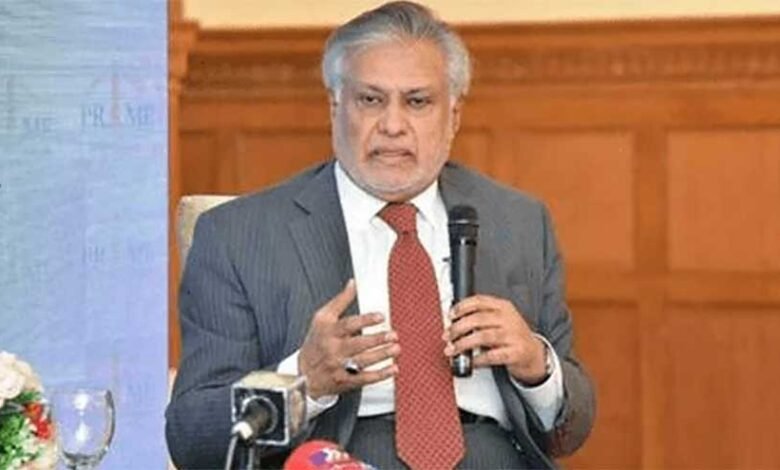
During his news briefing at the foreign office on Saturday, Pakistan’s foreign minister, Ishaq Dar, stated that the country’s diplomacy in 2025 produced important military, economic, and strategic results, including the settlement of a short-lived military dispute with India.
The foreign minister said that Pakistan’s military performance refuted India’s claim of regional supremacy and that a four-day confrontation with India in May marked a turning point for regional security during his annual news briefing at the foreign office in Islamabad.
“During the four-day conflict between May 6 and May 10, Allah gave Pakistan a significant victory,” Dar stated. “79 out of 80 drones were neutralised, and seven Indian aircraft were brought down.”
The minister denied Indian allegations that 15 Indian military stations had been assaulted by Pakistan, citing international confirmation that no such attacks had taken place.
“Such attacks leave traces in a digital world,” he said, adding that international powers eventually validated Pakistan’s stance.
Dar clarified that he was contacted by “US Secretary of State Marco Rubio, telling him that India was ready for a ceasefire,” and that Saudi Foreign Minister Prince Faisal bin Farhan then confirmed this.
He said that Pakistan had acted in accordance with Article 51 of the UN Charter.
Dar affirmed that in recognition of his “role in facilitating the ceasefire,” Pakistan subsequently nominated US President Donald Trump for the 2026 Nobel Peace Prize.
Speaking about the economy, Dar noted that Pakistan received a lot of foreign funding this year, including $3 billion from the US, $4 billion from Saudi Arabia, and $4 billion in state-to-state payments from China.
According to him, Pakistan and the United Arab Emirates (UAE) are working on a $1 billion rollover that is anticipated by March and involves UAE investment in Fauji Foundation Group enterprises.
Additionally, he said, Prime Minister Shehbaz Sharif obtained consent for a separate rollover of $2 billion that was due in January.
“Pakistan’s isolation has been lifted thanks to our results-driven diplomacy,” Dar stated.
“Power of the economy”
Regarding future goals, Dar stated that Pakistan wants to use its mineral, gas, and hydrocarbon resources to become a “economic power.”
Allah gave [Pakistan] both nuclear and missile capabilities. He emphasised that the nation had abundant natural resources, including oil, gas, and minerals. “What you need now is economic power,” he said.
He emphasised that they had now concentrated on making the nation an economic power and that they would be able to rule the entire Ummah (nation) once they achieved this position.
The US, China, and Saudi Arabia have already expressed interest in both onshore and offshore exploration blocks, he said.
Dar reaffirmed that the resolution of the Indian Illegally Occupied Jammu and Kashmir conflict (IIOJK) is a prerequisite for “permanent peace” in South Asia, adding that Pakistan had brought up the matter before the UN Security Council (UNSC).
A historic trip to Bangladesh
After years of blocked relations, he called his recent visit to Bangladesh a breakthrough and stated that Pakistan intends to cooperate more closely following the February elections in Dhaka.
US-related
Dar noted “bilateral trade of $13.28 billion, a $7 billion surplus for Pakistan in the last fiscal year,” as well as improved counterterrorism cooperation, as evidence of the better relations with the US. He declared, “Our relationship is now on a positive trajectory.”