In response to conflicting job market reports, Wall Street soars toward records.
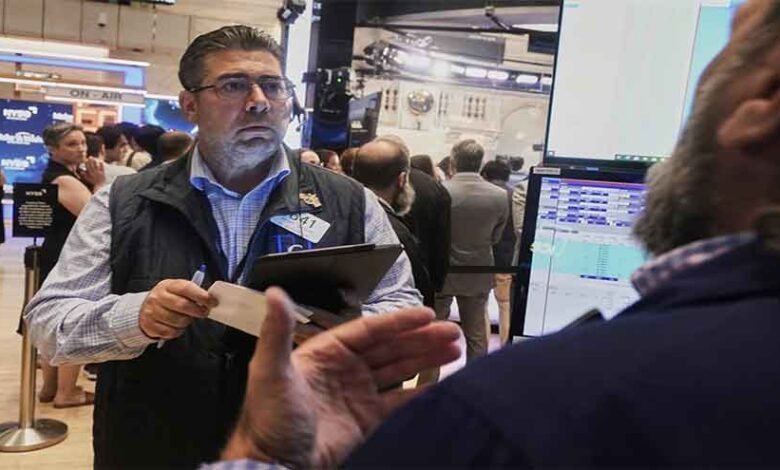
Following a mixed report on the U.S. labor market, which may postpone another rate drop by the Federal Reserve but does not completely rule it out, U.S. stocks are surging toward all-time highs on Friday.
The S&P 500 was on pace to surpass its all-time high achieved earlier in the week after rising 0.7% in afternoon trading. In addition to gaining 251 points, or 0.5%, the Dow Jones Industrial Average was on track to set a new high. As of 12:49 p.m. Eastern time, the Nasdaq composite had increased by 0.8%.
The increases followed the U.S. Labor Department’s announcement that, although the unemployment rate improved and was better than anticipated, employers employed fewer workers overall in December than analysts had predicted. It reaffirmed the possibility that the American labor market is in a “low-hire, low-fire” situation.
Following the announcement of a 20-year agreement to supply Meta Platforms with electricity from three of its nuclear units, power company Vistra surged 12.1% to take the lead on Wall Street. In order to electrify the data centers that drive their forays into artificial intelligence technologies, big tech companies have started negotiating a number of these agreements.Following President Donald Trump’s announcement of a promise to decrease mortgage rates, homebuilders and other housing industry participants saw robust first trade. Late Thursday, Trump demanded that $200 billion be purchased in mortgage bonds, just like the Fed has done in the past to lower mortgage rates by purchasing mortgage-backed bonds.
Following Vistra, building supply supplier Builders FirstSource saw one of the largest rises in the S&P 500, rising 11.6%. Lennar increased 7.6%, PulteGroup increased 6.6%, and D.R. Horton increased 6.4% among homebuilders.
They assisted in offsetting General Motors’ 3.6% decline. The automaker stated that its withdrawal from electric vehicles will cost them $6 billion in the final three months of 2025. In addition, GM was charged $1.6 billion in the previous quarter. The demand for EVs has been declining due to laxer fuel-emission standards and less tax incentives.
Following the release of a lower-than-expected profit for the most recent quarter, WD-40 fell 4.8%. The company maintained its financial projections for the following year, according to Chief Financial Officer Sara Hyzer, who stated that the disappointing statistics were mostly due to timing concerns rather than lower end-user demand.
Following the mixed jobs news, Treasury rates were neutral in the bond market.
The unemployment rate’s improvement was sufficient to cause traders to lower their expectations that the Fed will lower interest rates at its upcoming meeting later this month. According to data from CME Group, traders are currently predicting only a 5% possibility of happening, down from 11% the day before.
However, most traders still anticipate that the Fed will lower rates at least twice in the coming year. For the financial markets, the stakes are great whether they are right. While lower interest rates might boost the economy and increase investment values, they can also exacerbate inflation. Additionally, inflation has obstinately continued to rise above the Fed’s 2% target.
According to Ellen Zentner, chief economic analyst at Morgan Stanley Wealth Management, “a divided Fed is likely to stay that way until the data provide a clearer direction.” “This year is probably going to see lower rates, but the markets might need to exercise patience.”
Late on Thursday, the yield on the 10-year Treasury dropped from 4.19% to 4.17%. It usually follows projections for inflation and longer-term economic growth.
The two-year Treasury yield increased from 3.49% to 3.53%, more in line with expectations for the Fed’s near-term actions on short-term interest rates.
According to a different report that was made public on Friday morning, mood among American consumers is improving, especially among households with lower incomes. The University of Michigan’s preliminary analysis also stated that inflation forecasts for the next 12 months might be at their lowest point in a year, which may be more significant for the Fed. That could stop a vicious cycle in which rising expectations trigger actions that raise inflation even more.
across international stock markets, indexes increased across most of Europe and Asia.
Two of the largest advances in the globe occurred in Japan, where the Nikkei 225 soared 1.6% and the French CAC 40 increased 1.4%. The fashion firm behind Uniqlo, Fast Retailing, had a 10.7% increase in Tokyo following a roughly 34% year-over-year increase in its quarterly operational earnings. It raised its full-year projections.