Iran issues a warning about “instability” following the arrival of a US attack group
As a US Navy strike force commanded by an aircraft carrier positioned itself in Middle Eastern waters on Tuesday, Iran’s president issued a warning that US “threats” against the Islamic republic would only lead to instability.
President Donald Trump has sent the USS Abraham Lincoln to the region “just in case,” and Washington has not ruled out military action against Tehran for its crackdown on rallies, which rights organizations claim killed thousands of people.
In a phone conversation with Saudi Crown Prince Mohammed bin Salman, Iranian President Masoud Pezeshkian criticized US “threats,” claiming they were “aimed at disrupting the security of the region and will achieve nothing other than instability.”
A Revolutionary Guards commander warned Iran’s neighbors on Tuesday since the US too has many sites in the Middle East.
According to the Fars news agency, Mohammad Akbarzadeh, political deputy of the IRGC naval forces, stated, “Neighboring countries are our friends, but if their soil, sky, or waters are used against Iran, they will be considered hostile.”
Some opponents of the Iranian regime believe that action is the only way to effect change, but Trump has offered conflicting signals on the matter since Iran began cracking down on protests earlier this month, backed by a widespread internet shutdown.
“Next to Iran, we have a sizable armada. “Bigger than Venezuela,” Trump said Monday on the Axios news website, weeks after Nicolas Maduro, the president of the Latin American country, was taken prisoner by the US military.
“They want to make a deal,” he continued. I am aware of this. They made multiple calls. They’d like to speak.
Despite the lack of diplomatic ties between the two adversaries, Tehran has previously stated that a line of communication is open between US envoy Steve Witkoff and Foreign Minister Abbas Araghchi.
According to Axios, Trump refused to talk about his preferences or the options that his national security team offered him.
In an effort to topple the regime that has governed Iran since the Islamic revolution that overthrew the shah in 1979, analysts say options include targeted attacks against the leadership under supreme leader Ayatollah Ali Khamenei or strikes on military installations.
“WEAKEST POINT”
Several US intelligence reports have been sent to Trump, according to the New York Times, “indicating that the Iranian government’s position is weakening” and that its grasp on power “is at its weakest point” since the collapse of the Taliban.
US Senator Lindsey Graham told the newspaper that “the goal is to end the regime” and that he had just discussed Iran with Trump.
“They may stop killing them today, but if they’re in charge next month, they’ll kill them then,” he stated in reference to the way the government handles demonstrators.
In recent days, Iranian officials have seemed cautious about adding fuel to the fire.
However, Revolutionary Guards spokesman Mohammad Ali Naini was quoted by the conservative Hamshahri newspaper on Tuesday as stating that “if their aircraft carrier made a mistake and entered Iranian territorial waters, it would be targeted”; however, the newspaper then withdrew the claim and apologized to Naini.
Iran was “ready for a major response” and would take control of the vital Strait of Hormuz, a crucial transit corridor for petroleum supplies, according to the conservative Javan daily.
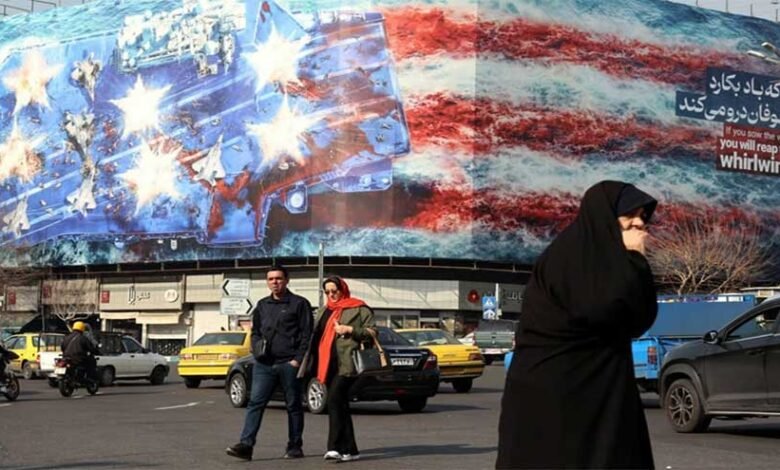
In the meantime, an anti-US billboard that purports to depict the destruction of an American aircraft carrier has surfaced in Tehran.
“Mass arrests, incitement”
Rights organizations have called the crackdown the deadliest against protests in Iran’s history and caution that the nearly three-week internet outage has made it difficult to compile tolls, which they claim is intended to conceal the severity of the repression.
On Tuesday, Netblocks reported sporadic connectivity but cautioned that internet access was still “heavily filtered on a whitelist basis” and that users would still require workarounds.
The US-based Human Rights Activists News Agency (HRANA) reported an updated death toll, confirming that 6,126 individuals had been slain, including 49 bystanders, 214 security force members, 86 juveniles, and 5,777 demonstrators.
However, the group, which has tracked the protests every day since they started and has a wide network of informants within Iran, added that it was still looking into another 17,091 potential deaths.
It stated that at least 41,880 persons had been taken into custody.
“Security agencies continue to pursue an approach centred on mass arrests, intimidation, and control of the narrative,” stated HRANA.
Iran International, a Persian-language television network headquartered outside of Iran, said over the weekend that security forces killed over 36,500 Iranians during January 8 and 9, citing sources, records, and reports.
The report could not be verified right away.