Pakistan becomes a vital economic link between Central Asia, South Asia, and Eurasia.
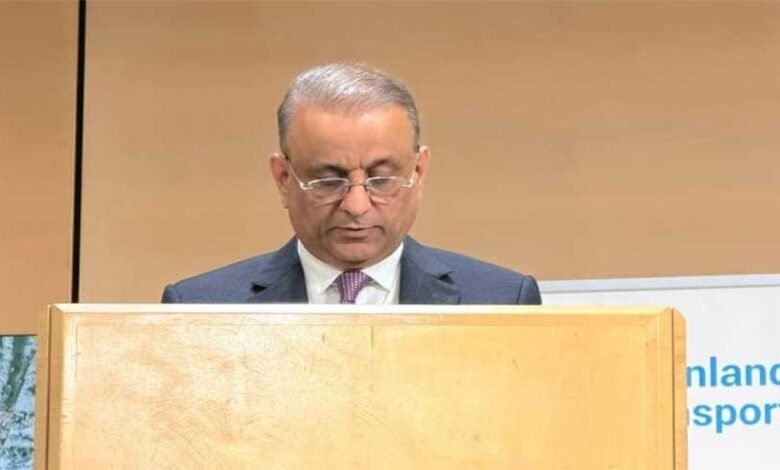
Abdul Aleem Khan, the Federal Minister of Communications, emphasized Pakistan’s pivotal function as a “Economic Bridge” that connects South Asia, Central Asia, the Middle East, and Eurasia on Thursday.
“Pakistan’s strategic integration into the Belarus, Russia, and Central Asia corridors represents the dawn of a new era in regional connectivity,” he said in a news release received today while speaking at the 88th session of the UNECE Inland Transport Committee in Geneva.
According to the minister, the country is essentially extending its doors to supply landlocked Central Asian Republics and Russia with high-efficiency trade channels by utilizing the enormous triumphs of the China-Pakistan Economic Corridor (CPEC).
Pakistan’s proactive facilitation of regional transit trade to the Russian Federation and beyond through six established land corridors is a key component of this ambition, he continued. High-capacity lines via Turkey, Azerbaijan, and Iran, as well as specialized China–Kazakhstan connecting routes, are among these vital arteries, he said.
In addition, Pakistan has a lot of room to grow northward by using the Quadrilateral Traffic in Transit Agreement (QTTA) route that connects Kazakhstan and Kyrgyzstan as well as several Trans-Afghan corridors to connect with Central Asian Republics.
“The first Kazakh cargo shipment to the UAE successfully transited via Pakistan in June 2024, demonstrating the country’s logistical viability for intercontinental trade,” Abdul Aleem Khan remarked, marking a significant milestone in this trip.
Aleem Khan emphasized Pakistan’s top-notch logistics and cited the accomplishment of more than 1,800 TIR operations as verifiable proof of the nation’s operational preparedness. He described the M-6 Sukkur–Hyderabad Motorway project as a premium, high-yield opportunity for foreign investors and welcomed stakeholders from around the world to take advantage of it. This project, which offers approximately 30% guaranteed equity, is expected to contribute significantly to improving regional connectivity while providing steady and predictable earnings.
He stated that Pakistan has set aside a 100-acre terminal at Gwadar Port exclusively for Central Asian nations in order to strengthen these ties and guarantee that Karachi Port continues to be a strong seaport for landlocked neighbors.
The minister highlighted a digital and diplomatic transformation that goes beyond physical highways in order to make trade smooth. In order to ensure conformity with international laws and UN treaties, the Ministry of Communications is now leading an extensive effort for the digitization and openness of traffic data.
Pakistan is no longer just a transit region because to the National Logistics Cell’s (NLC) cooperation with Uzbekistan and Kazakhstan, the “Visa-on-Arrival” facility for 126 nations, and other initiatives. Rather, it has solidified its position as a proactive center of world economic activity and a driving force behind a revolution in regional trade.