Pakistan demands that the discussion of human rights be depoliticized.
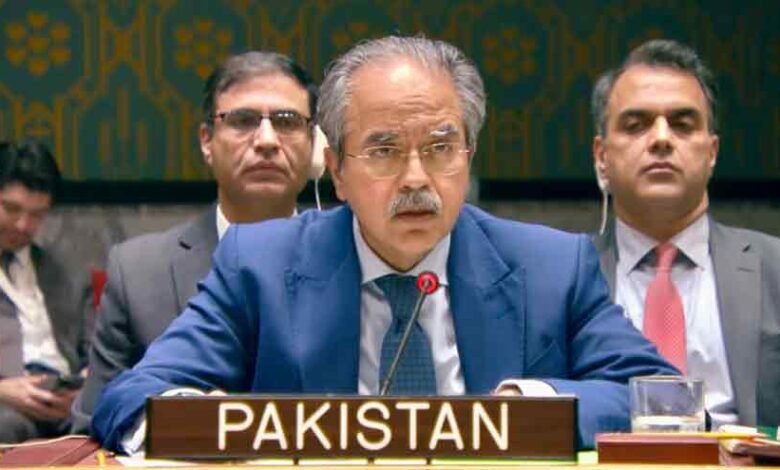
Pakistan has connected the establishment of enduring peace and the defense of human rights to resolving all instances of foreign occupation and denial of self-determination, even as it maintains that the Human Rights Council (HRC) must continue to be a platform for communication and collaboration rather than conflict or politicization.
As Pakistan’s Permanent Representative to the UN, Ambassador Asim Iftikhar Ahmad, made reference to Palestine and Jammu & Kashmir, where peoples still experience tyranny and dispossession, in a national statement during the General Assembly’s presentation of the Report of the Human Rights Council. In order to respect international law and defend the rights of all occupied and oppressed peoples without distinction, he encouraged the Council to effectively use its preventative authority.
In order to successfully further the human rights agenda, Ambassador Asim made a number of recommendations. According to him, the Council’s legitimacy and operation depend heavily on sufficient, steady, and consistent funding.
“Without addressing the funding crisis hampering technical cooperation and capacity-building, the Council’s ability to deliver will remain constrained,” he stated.
He said that Pakistan has consistently emphasized the need to simplify mandates, prevent duplication, and improve coordination across institutions, arguing that the proliferation of mandates has increased gaps between the Council’s tasks and its limited resources. He asserted that the emphasis should be on quality rather than quantity, making sure that every mandate provides value and makes a significant contribution to the advancement of all rights.
The UN Ambassador for Pakistan went on to say that all rights should receive equal attention. He pointed out that economic, social, and cultural rights, especially the right to development, are sometimes given less priority than civil and political rights, which receive an excessive amount of attention and funding.
He claimed that universality, objectivity, and cooperation are embodied in the Universal Periodic Review (UPR), one of the Council’s most successful procedures. According to him, Pakistan emphasizes how crucial it is to maintain its integrity and universality.
In reference to Pakistan’s recent election as a 2026–2028 member of the Human Rights Council, Ambassador Asim Iftikhar Ahmad reiterated Pakistan’s resolve to participate in a fair, moral, and beneficial manner.
“We will keep advocating for the advancement of all human rights, strengthening the voice of the Global South, and fostering consensus-building. Pakistan will continue to draw attention to human rights abuses, such as the denial of the right to self-determination and the concerning increase in Islamophobia, in its capacity as Coordinator of the OIC Group on Human Rights and Humanitarian Issues,” he underlined.