Pakistan reiterates its objection to the UNSC’s new permanent members.
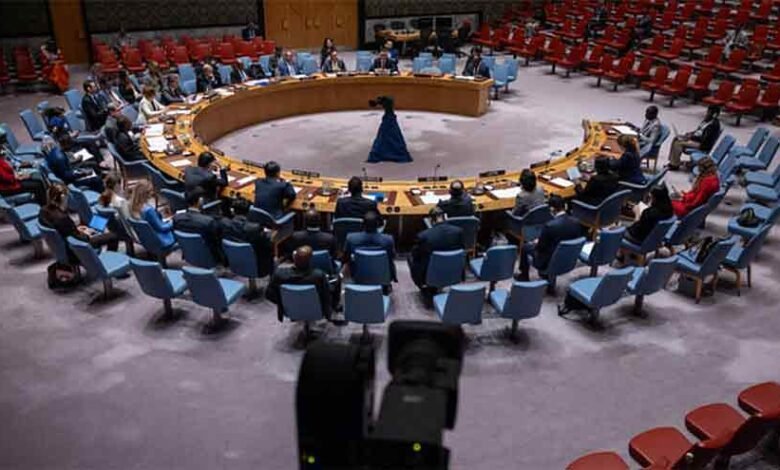
Pakistan has reiterated its opposition to the UN Security Council’s decision to add new permanent members, claiming that doing so will increase the dysfunction of the 15-member body and go against the principle of sovereign equality.
Ambassador Asim Iftikhar Ahmad, Pakistan’s permanent representative to the UN, stated during a reopened session of the lengthy Intergovernmental Negotiations (IGN) to reform the Security Council that the call for individual permanent membership is obviously against the reform tenets.
According to Ambassador Asim Ahmad, who is a member of the Uniting for Consensus (UfC) group, Pakistan supports the expansion of only elected, non-permanent seats in order to improve democratic participation and guarantee “REFORM FOR ALL – PRIVILEGE FOR NONE.”
In February 2009, the General Assembly launched extensive talks to reform the Security Council on five main topics: membership categories, the veto issue, regional representation, the size of an expanded Security Council, and the council’s operational procedures and relationship with the General Assembly.
The G-4 nations—India, Brazil, Germany, and Japan—continue to demand permanent seats on the Security Council, while the UfC group, lead by Italy and Pakistan, is against any new permanent members. As a result, efforts to restructure the Council are still stalled. claiming that “new centers of privilege” will be created.
A new category of members, not permanent members, with longer terms and the potential to be re-elected has been proposed by UfC as a compromise.
Ten non-permanent members chosen for two-year terms and five permanent members—Britain, China, France, Russia, and the United States—make up the Security Council at the moment.
The goal of the IGN framework is to restructure the Council in a way that will increase its effectiveness, accountability, and representation.
The drive for individual permanent membership cannot serve as a foundation for reform guided by those established principles, the Pakistani envoy stressed in his speech.
He claimed that the vast majority of UN members understand that the veto and permanent membership are the main causes of the stagnation and inaction that the Council has all too frequently displayed over the years.
Ambassador Asim Ahmad noted, “For them, this is not a side issue; it is the primary fault line that compromises the Council’s legitimacy and efficacy.”
“The demand for special privileges must have no place in this reform debate, which has involved a great deal of work and comes at a time when the multilateral system is under tremendous strain due to calls for reform for a UN that is fit for purpose.”
He emphasized Pakistan’s “consistent” stance and stated that new permanent members run the risk of strengthening and extending the “inordinate” influence of the current permanent members rather than countering it.
The Pakistani envoy said, “A larger oligarchy is no antidote to an elite power club, and two wrongs cannot make a right.”
“A circle of permanency will remain closed even if it is enlarged. It is understandable why certain P-5 (permanent members) are pleased to see this group grow, mostly to preserve their own antiquated standing in the current Council.
According to him, Pakistan believes that a more democratic and accountable approach, which includes a significant increase in elected, non-permanent members, is the best method to balance the disproportionate power of the five permanent members. This would improve transparency, inclusivity, and accountability in the Council’s decision-making process while upholding the principle of sovereign equality, he continued, adding that it would tip the internal balance of an expanded Council in favor of the wider membership and guarantee that elected members hold the majority needed to adopt resolutions.
Ambassador Asim Ahmad stated that Pakistan is fully aware of and respectful of Africa’s demand for permanent seats, which is on behalf of the entire region. This is in contrast to other proposals that aim to achieve permanent membership for individual states, which are divisive.
The Pakistani envoy emphasized the need to accommodate underrepresented regions and the interests of sub-regional and cross-regional groups, such as SIDS (Small Island Developing States) and the OIC, as also stipulated and agreed in the UN’s Pact for the Future. “Any concept, in our view, must ensure genuine rotation and fair regional representation,” the envoy stated.
In reference to G-4, he stated, “The key word here is flexibility, and we heard a lot of that word this morning, but there are others who remain fixated.”
They call for negotiations but do not take any action. In other words, without flexibility, convergences that must form the foundation of a so-called integrated model cannot be accomplished.