President Zardari speaks to Parliament about India’s hydro-aggression, the Middle East crises, and Kashmir.
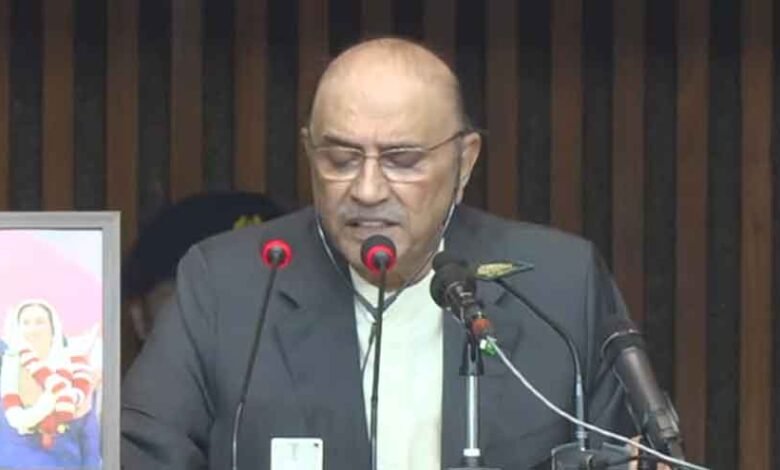
Addressing a joint session of Parliament on Monday that was marred by protests from the opposition, President Asif Ali Zardari said that Pakistan would not permit any foreign or domestic group to utilize neighboring territory to threaten its peace.
Strong messages on Middle East tensions, Kashmir, regional security, and what he called India’s increasing “water aggression” were all included in the speech. Speaker of the National Assembly Ayaz Sadiq presided over the meeting, which was attended by Prime Minister Shehbaz Sharif as well as top military and civil officials.
The president referred to the speech as his ninth before Parliament in that capacity and said it served as a reminder of institutional accountability and democratic continuity. Before the president addressed the floor, the national anthem and recital of the Quran kicked off the proceedings.
Address to Parliament
Zardari emphasized that the republic’s strength is based on the military’s professionalism, the public’s tenacity, and the supremacy of the constitution. At the beginning of the parliamentary year, he called for a fresh sense of national resolve, stating that Pakistan had been put to the test in “profound and complex ways” over the previous ten months.
However, opposition members frequently interrupted his speech with slogans calling for the release of former prime minister Imran Khan. The disruption was momentarily heightened when opposition legislators assembled in front of the speaker’s dais.
The president went on in spite of the commotion, citing the constitutional heritage of Benazir and Zulfikar Ali Bhutto as well as the democratic ideal of Quaid-e-Azam Muhammad Ali Jinnah.
A warning about security
Regarding regional security, Zardari stated that Pakistan had addressed what he called unwarranted challenges on its borders with “strategic restraint and firm resolve.” He said that the military’s sacrifices and professionalism have guaranteed the stability of the country.
The president also cited a monitoring report from the UN Security Council that warned of the threat posed by extremist organizations operating out of Afghanistan. He called on the Afghan Taliban government to destroy safe havens that are utilized by organizations such as the Balochistan Liberation Army and Tehreek-i-Taliban Pakistan.
He declared, “Pakistan’s soil is sacred.” “We will not permit any domestic or foreign entity to undermine our peace by using neighboring territory.”
Concern for the Middle East
Speaking about broader geopolitics, the president expressed profound worry over the worsening Middle East scenario. He stated that while diplomatic talks were underway, Pakistan denounced the war on Iran and opposed unilateral military action against any state.
He also criticized Iranian strikes on Gulf nations at the same time, calling on all parties to follow international law and use the utmost caution.
He called for negotiated solutions to avoid a more serious crisis and stated that “the sooner stability returns to the region, the sooner the world can rebuild fractured trust.”
Conflict over water
Water security was a major theme of the speech, and the president accused India of trying to control river flows against the terms of the Indus Waters Treaty.
He called New Delhi’s efforts “hydro-terrorism” and said that putting the deal on hold would jeopardize regional stability and Pakistan’s agricultural industry.
He stated that Pakistan would defend its water rights with unity and legal clarity, adding that “unilateral blockage of water is not permitted by international law.”
Zardari also restated Islamabad’s long-standing stance on Kashmir, stating that a settlement of the conflict was still necessary for enduring peace in South Asia. He called on India to shift from conflict to meaningful communication.
Pay attention to the economy.
Regarding domestic priorities, the president attributed the government’s ability to steer the economy away from what he called a near-collapse in 2022 to economic stability and national security. In order to restore industry, he emphasized the necessity of equitable growth, tax changes, and decreased energy costs.
He urged better water management and climate-resilient agriculture while cautioning that energy reform was still necessary for sustainable growth.
The high-profile aspect of the annual parliamentary address as Pakistan deals with growing regional and economic strains was highlighted by the attendance of province chief ministers and governors, senior MPs, and foreign ambassadors.Addressing a joint session of Parliament on Monday that was marred by protests from the opposition, President Asif Ali Zardari said that Pakistan would not permit any foreign or domestic group to utilize neighboring territory to threaten its peace.
Strong messages on Middle East tensions, Kashmir, regional security, and what he called India’s increasing “water aggression” were all included in the speech. Speaker of the National Assembly Ayaz Sadiq presided over the meeting, which was attended by Prime Minister Shehbaz Sharif as well as top military and civil officials.
The president referred to the speech as his ninth before Parliament in that capacity and said it served as a reminder of institutional accountability and democratic continuity. Before the president addressed the floor, the national anthem and recital of the Quran kicked off the proceedings.
Address to Parliament
Zardari emphasized that the republic’s strength is based on the military’s professionalism, the public’s tenacity, and the supremacy of the constitution. At the beginning of the parliamentary year, he called for a fresh sense of national resolve, stating that Pakistan had been put to the test in “profound and complex ways” over the previous ten months.
However, opposition members frequently interrupted his speech with slogans calling for the release of former prime minister Imran Khan. The disruption was momentarily heightened when opposition legislators assembled in front of the speaker’s dais.
The president went on in spite of the commotion, citing the constitutional heritage of Benazir and Zulfikar Ali Bhutto as well as the democratic ideal of Quaid-e-Azam Muhammad Ali Jinnah.
A warning about security
Regarding regional security, Zardari stated that Pakistan had addressed what he called unwarranted challenges on its borders with “strategic restraint and firm resolve.” He said that the military’s sacrifices and professionalism have guaranteed the stability of the country.
The president also cited a monitoring report from the UN Security Council that warned of the threat posed by extremist organizations operating out of Afghanistan. He called on the Afghan Taliban government to destroy safe havens that are utilized by organizations such as the Balochistan Liberation Army and Tehreek-i-Taliban Pakistan.
He declared, “Pakistan’s soil is sacred.” “We will not permit any domestic or foreign entity to undermine our peace by using neighboring territory.”
Concern for the Middle East
Speaking about broader geopolitics, the president expressed profound worry over the worsening Middle East scenario. He stated that while diplomatic talks were underway, Pakistan denounced the war on Iran and opposed unilateral military action against any state.
He also criticized Iranian strikes on Gulf nations at the same time, calling on all parties to follow international law and use the utmost caution.
He called for negotiated solutions to avoid a more serious crisis and stated that “the sooner stability returns to the region, the sooner the world can rebuild fractured trust.”
Conflict over water
Water security was a major theme of the speech, and the president accused India of trying to control river flows against the terms of the Indus Waters Treaty.
He called New Delhi’s efforts “hydro-terrorism” and said that putting the deal on hold would jeopardize regional stability and Pakistan’s agricultural industry.
He stated that Pakistan would defend its water rights with unity and legal clarity, adding that “unilateral blockage of water is not permitted by international law.”
Zardari also restated Islamabad’s long-standing stance on Kashmir, stating that a settlement of the conflict was still necessary for enduring peace in South Asia. He called on India to shift from conflict to meaningful communication.
Pay attention to the economy.
Regarding domestic priorities, the president attributed the government’s ability to steer the economy away from what he called a near-collapse in 2022 to economic stability and national security. In order to restore industry, he emphasized the necessity of equitable growth, tax changes, and decreased energy costs.
He urged better water management and climate-resilient agriculture while cautioning that energy reform was still necessary for sustainable growth.
The high-profile aspect of the annual parliamentary address as Pakistan deals with growing regional and economic strains was highlighted by the attendance of province chief ministers and governors, senior MPs, and foreign ambassadors.