Prime Minister Shehbaz Sharif participates with global leaders as Trump convenes the inaugural Gaza Board of Peace conference.
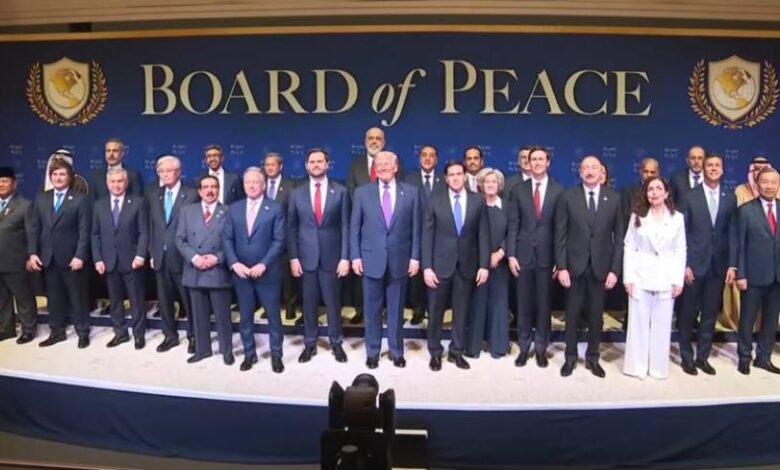
Prime Minister Shehbaz Sharif has arrived in Washington for a three-day official visit to participate in the maiden session of the Board of Peace at the request of United States President Donald Trump.
The senior assembly, concentrating on initiatives to conclude the fighting in Gaza and manage post-conflict reconstruction, is convened at the Donald J. Trump US Institute of Peace.
The prime minister is set to address the event and interact with senior US officials and counterparts from participating states. The event convenes delegates from around 45 nations, including Saudi Arabia, Indonesia, and Azerbaijan, signifying one of the most scrutinized diplomatic efforts for Gaza in recent months.
Worldwide convergence
The summit occurs almost three months following the UN Security Council’s endorsement of a US-supported ceasefire proposal, which encompasses a two-year mandate for the Board of Peace to oversee the demilitarization and rehabilitation of Gaza. The ceasefire is tenuous, as Israel and Hamas allege violations against one another.
According to the truce’s stipulations, Israeli forces retreated to locations beyond a designated yellow line, however they continue to maintain control over more than fifty percent of the land. Principal unsolved matters encompass the disarmament of Hamas, the total departure of Israeli soldiers, the magnitude of reconstruction efforts, and the continuous provision of humanitarian aid to Gaza.
Prior to the meeting, President Trump declared that board members have committed $5 billion, roughly £3.7 billion, for reconstruction initiatives. The sum constitutes a portion of the projected $70 billion, or £52 billion, necessary for the reconstruction of Gaza following two years of conflict.
Inquiries regarding representation
Although delegations from 47 nations are anticipated, some prominent European allies, including as the UK, Germany, and France, have denied the invitations. The European Union has chosen not to participate on the board, while the European Commission is sent monitors.
The board lacks Palestinian representation, whereas Israel occupies a seat. The lack of Palestinian involvement has garnered attention in international circles, as discussions focus on governance, reconstruction, and long-term security arrangements in Gaza.
Hungary is the sole European Union nation anticipated to be officially represented as a board member. Other European nations, such as Italy, Poland, the Czech Republic, and Romania, are dispatching senior officials but are not members of the board itself.
Security context
The summit occurs amid increased regional tensions. Reports indicate that the United States has markedly boosted its military presence in the Middle East, deploying modern F-35 and F-22 fighter fighters, while a second aircraft carrier is en route to the region.
U.S. legislators Ro Khanna and Thomas Massie have declared their intention to propose a war powers resolution designed to restrict any military action against Iran without congressional authorization. Simultaneously, Russia and Iran have executed collaborative naval exercises in the Gulf of Oman, with the Kremlin advocating for moderation in light of rising tensions.
Humanitarian issues in Gaza persist as critical. A research published in The Lancet Global Health concluded that around 75,000 individuals were killed in the initial 16 months of the conflict, a figure far above prior official estimates. As of February 16, the Palestinian Health Ministry reported a minimum of 72,063 confirmed fatalities.