Punjab changes school hours because the smog situation is becoming worse.
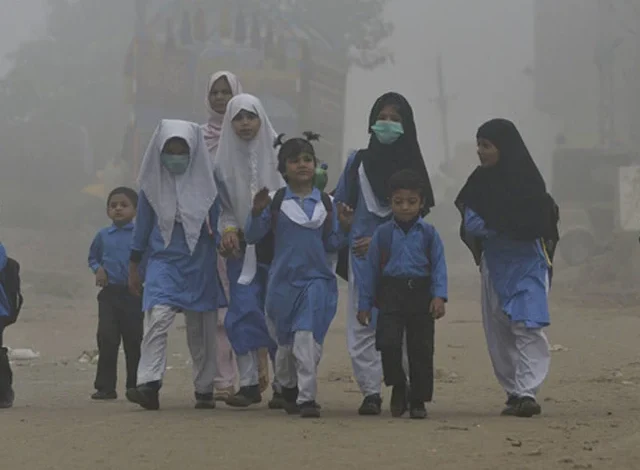
Because of the deteriorating pollution conditions, the Punjab Education Department has changed the hours of all schools in the province. The notice says that no school will be able to open before 8:45am.
An official notice says that the hours for all public and private schools in Punjab have altered since the smog has gotten worse.
It further said that any school that opens before 8:45 a.m. will be breaking the law and could be fined between Rs100,000 and Rs1 million.
The Punjab government formally changed the hours of education, starting right away on October 27, 2025, and lasting until April 15, 2026.
Rana Sikandar Hayat, the Provincial Education Minister, announced a new timetable on Sunday. It says that all schools would now open at 8:45 a.m. and end at 1:30 p.m. Teachers, students, and parents have been told to stick to the new times.
According to the notice, single-shift schools will be open from 8:45 a.m. to 1:30 p.m., and on Fridays, lessons will stop at 12:30 p.m. The first shift in double-shift schools will be from 8:45 a.m. to 1:30 p.m., and the second shift will be from 1:00 p.m. to 4:00 p.m. Teachers have been told to stay on duty from 8:30 a.m. to 2:00 p.m. and from 8:30 a.m. to 12:30 p.m. on Fridays.
The air quality in Punjab’s big cities is still very bad, and the air pollution is still very high.
The International Environmental Monitoring Agency IQAir said that the Air Quality Index (AQI) hit its highest point of 500 in Dera Ghazi Khan and Kasur at 9 a.m., making both cities among of the most polluted in the world. These levels were considerably higher than those in Lahore, which has long been thought to be the most polluted city in the country.
Read: The skies in Punjab are becoming poisonous, and Lahore and Kasur are two of the worst cities.
Banned vehicles without green markings
The Punjab government is doing a lot of things to fight smog, and one of them is to instantly ban automobiles that don’t have green stickers or legitimate fitness certificates.
The smog alert season will start on November 1 and last until January 31, 2026, or until the smog, which is called a “black haze,” goes away.
The Punjab Environmental Protection Department has given the green light for an anti-smog campaign across the province that will commence on November 15. It will target any vehicles that release smoke, especially large public and goods transport that runs from Rawalpindi and Islamabad to other districts.
Closed marble factories
According to a press release from Thursday, the Pakistan Environmental Protection Agency (Pak-EPA) and the Islamabad Capital Territory (ICT) Administration worked together to close several marble factories near Sector B-17, Islamabad, that were breaking the Pakistan Environmental Protection Act, 1997, over and over again. This was part of a major enforcement operation against industrial air pollution.
Read more: Cars without green stickers are not allowed in Punjab.
Muhammad Saleem Shaikh, a media spokesperson for the Ministry of Climate Change and Environmental Coordination, said, “The action was part of Pak-EPA’s ongoing campaign to reduce smog and control dust emissions from marble and granite processing units, which were identified as major contributors to the declining air quality in and around the federal capital.”
Khalid Mehmood Chadhar, Director (EIA/Monitoring), and Muhammad Ramazan, Deputy Director (Legal/Enforcement), of Pak-EPA Islamabad were in charge of the operation. Nazia Zeb Ali, the Director General of Pak-EPA Islamabad, was in charge of it. During the inspection, which was done with a magistrate present, it was determined that multiple marble processing units had not followed repeated notices and warnings from the appropriate authority.
According to Nazia Zeb Ali, the Director General, cutting and polishing marble releases a lot of dust and small particles into the air, which are two of the main causes of air pollution. This pollution has gotten worse during the current smog season, which is bad for both public health and visibility.
She went on to say that the non-compliant units were sealed and Environmental Protection Orders (EPOs) were issued under the appropriate parts of the legislation for breaking environmental rules again and over again.