The EU ‘expects’ the US to uphold the trade agreement while Trump raises tariffs.
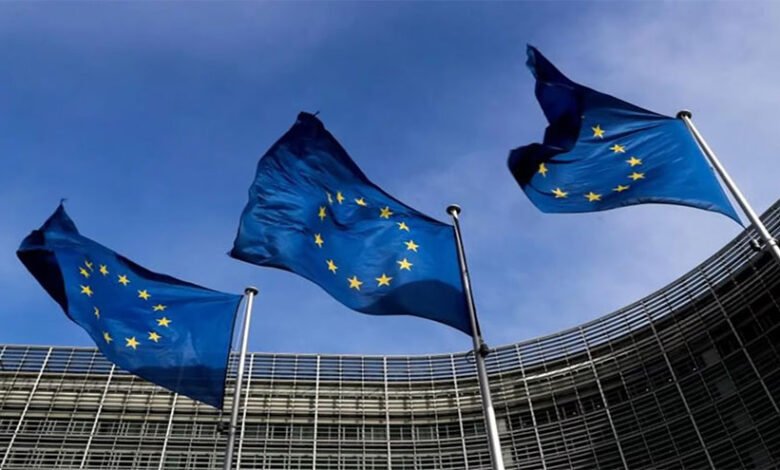
A day after a negative Supreme Court decision, President Donald Trump announced further worldwide tariff hikes on Sunday, prompting the European Commission to urge Washington to adhere to the provisions of the trade agreement reached with the EU last year.According to a commission statement, “A deal is a deal.”As the biggest trading partner of the US, the EU expects the US to uphold its obligations under the Joint Statement, just as the EU does,” it continued.In light of the recent Supreme Court decision regarding the International Emergency Economic Powers Act (IEEPA), the European Commission wants complete clarity on the actions the United States plans to take.
On Saturday, Trump temporarily increased the global levy on goods into the US to 15%.
Only a day after the Supreme Court declared that a large portion of his global tariffs campaign was unlawful, the action brought a new shock of uncertainty.
Last year, an agreement was reached between the US and the EU that fixed US tariffs on the majority of European exports at a maximum of 15%.The most competitive treatment for EU goods must remain, and tariffs cannot be raised above the previously agreed-upon clear and comprehensive ceiling, the commission stated.
It cautioned that “when applied unpredictably, tariffs are inherently disruptive, undermining confidence and stability across global markets and creating further uncertainty across international supply chains” .
ASKING FOR EXPLAINATION
According to the EU executive, EU Trade Commissioner Maros Sefcovic held a conversation with US Trade Representative Jamieson Greer and Commerce Secretary Howard Lutnick on Saturday, and the EU stated it was still “in close and continuous contact” with Trump’s administration.
Despite the Supreme Court’s decision, Greer told US television CBS on Sunday that Washington’s agreements with China, the European Union, and other allies were still in effect.Thus, we are actively conversing with them. He told the “Face the Nation” show, “We want them to realize that these deals are going to be good deals.”
“We expect to stand by them,” he continued. We anticipate that our partners will support them.
However, Christine Lagarde, president of the European Central Bank, stated on the same program that she was unsure of the ramifications of the US court ruling.”Hopefully, it will be explained,” she continued.
The EU-US accord was supposed to be approved by the European Parliament’s trade committee on Tuesday, but the Supreme Court’s ruling raises questions about that.
“TARIFF CHAOS” in the US
“The head of the committee, Bernd Lange, stated that he would call for putting “legislative activity on hold until we get a proper legal evaluation and unambiguous guarantees from the US side” at a meeting of parliament’s political groups Tuesday.”The US administration is a complete mess with tariffs. Lange added, “There are still unanswered questions and increasing uncertainty for the EU and other US trading partners. No one can make sense of it anymore.”Before taking any further action, clarity and legal certainty are required,” he continued.
Even if Trump’s proposed tariffs might be legally challenged, analysts at ING Bank warned on Sunday that they might merely be “smoke and mirrors” to gain time for another tariff alternative.
For instance, they noted, “that could be tariffs based on unfair trade practices or violations of trade agreements.”Now, it’s unclear if the (European) Parliament would insist on a complete reworking of the agreement,” ING continued.
The US could still employ further tariffs “to pressure the EU to return to the negotiating table” even if they did.
The Supreme Court’s decision was a startling rebuke of Trump from a court that has mostly supported him since he took office again.
Dismantling Trump’s flagship economic agenda, which has agitated the global trading order, was a significant political loss.
Numerous nations have stated that they are researching the Supreme Court’s decision and Trump’s ensuing tariff declarations.