The EU seeks to revive the U.S. trade agreement but cautions that it will protect itself if faced with further threats.
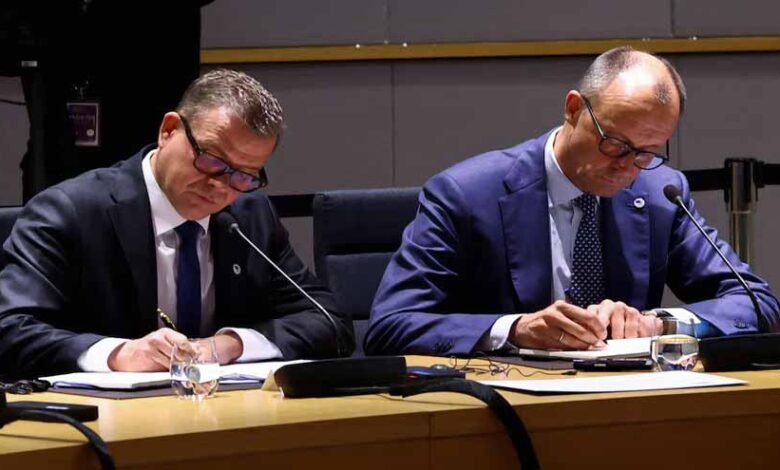
EU leaders expressed satisfaction regarding Donald Trump’s reversal on Greenland during their emergency session in Brussels late Thursday.
The leaders expressed their desire for the EU-U.S. trade agreement to resume progress following the European Parliament’s suspension of its ratification in response to U.S. pressure about the acquisition of Greenland.
While expressing a desire to enhance transatlantic cooperation, the EU leaders cautioned that they were prepared to respond should Trump pose a danger once more.
The Thursday evening session was organized following the U.S. warnings of substantial tariffs and maybe military intervention in Greenland, before retracting those threats and indicating that an agreement regarding the Arctic island was imminent.
European Commission leader Ursula von der Leyen stated, “We achieved success by maintaining firmness,” in reference to Trump retracting his threats against Europe concerning Greenland.
However, Trump’s threats significantly undermined Europe’s faith in its ally, according to EU officials and leaders.
Kaja Kallas, the bloc’s foreign policy leader, stated upon her arrival to the summit, “Transatlantic relations have undoubtedly suffered a significant setback over the past week.”
TRUMP’S REVERSAL IS POSITIVE, YET EUROPE REMAINS CAUTIOUS
The extraordinary summit, assembled to reevaluate the EU-U.S. relationship, failed to reach any definitive conclusions.
“The situation is stabilizing, and we should embrace that,” stated French President Emmanuel Macron.
Macron said reporters, “We remain highly vigilant and prepared to employ the tools at our disposal should we again become the target of threats,” alluding to the “bazooka” trade sanctions the union had contemplated implementing.
European Council chief Antonio Costa stated that the EU “will defend itself, its member states, its citizens, and its companies against any form of coercion.”
The majority of leaders indicated that the relationship with the United States is crucial for the EU, and they are prepared to exert significant effort to sustain it, while also anticipating diligence and respect from Washington in return.
“Europe is unwilling to discard 80 years of favorable transatlantic relations due to disagreements… we are prepared to invest our time and energy in this,” Kallas stated.
CEASE ALL THREATS
European Union states remain cautious of a potential reversal by a capricious president widely perceived as a bully whom Europe must confront.
Trump has crossed the Rubicon. He may repeat the action. According to one EU ambassador, a return to the previous state is impossible, emphasizing that the bloc must reduce its substantial dependence on the U.S. in various domains.
We must endeavor to maintain proximity to him (Trump) while striving for greater independence from the U.S. It is likely a lengthy procedure.
Danish Prime Minister Mette Frederiksen expressed her readiness to engage in discussions regarding security cooperation in Greenland with the United States, provided that their sovereignty is completely respected.
“We must collaborate respectfully without resorting to threats,” she stated.
The United States possesses considerable influence.
After decades of dependence on Washington for defense within the NATO alliance, the bloc lacks the requisite intelligence, transportation, missile defense, and production capabilities to safeguard itself against a potential Russian assault.
This provides the U.S. considerable leverage.
The United States is Europe’s largest commercial partner, rendering the European Union susceptible to Trump’s tariff policies aimed at diminishing Washington’s trade deficit in products and, as exemplified by Greenland, pursuing additional objectives.
A fundamental inquiry will be the extent to which Europeans wish to maintain proximity to the United States and the degree of trust that persists. While it is asserted that Europeans must unite and adopt a cohesive position, historical connections differ among nations.
“I continue to regard the United States as our closest ally,” stated Lithuanian President Gitanas Nauseda.
Others exhibited greater caution.
It is crucial for our friends in Washington to see the distinction between domination and leadership. “Leadership is satisfactory,” stated Poland’s Prime Minister Donald Tusk. “Coercion is an ineffective approach.”
EU-US TRADE AGREEMENT
Officials stated that the EU was prepared to implement a series of retaliatory tariffs on €93 billion ($108.74 billion) of U.S. goods and anti-coercive measures if Trump proceeded with his proposed tariffs set to commence on February 1.
European parliamentarians are expected to recommence their efforts on ratifying the trade agreement following Trump’s retraction of his threats, stated European Parliament President Roberta Metsola.