The Finance Minister Aurangzeb and the Saudi minister engage in discussions regarding economic collaboration in Riyadh.
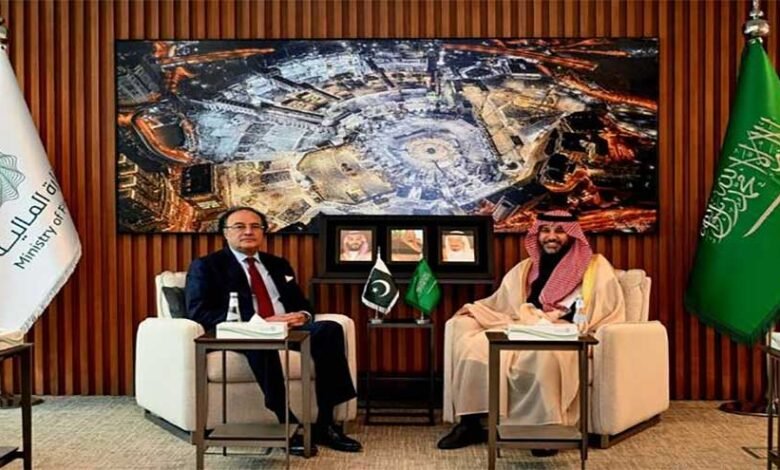
On Thursday, Finance Minister Muhammad Aurangzeb engaged in discussions with Saudi Arabia’s Vice Minister of Finance Abdulmuhsen Al-Khalaf in Riyadh, focusing on macroeconomic trends and strategies to further collaboration as Islamabad endeavors to stabilize its economy.
In Thursday’s meeting, “the Ministers discussed the favorable macroeconomic trends of Pakistan’s economy and their collective commitment to further improve the economy,” stated the finance ministry.
Aurangzeb acknowledged the Kingdom’s bilateral and multilateral assistance in fortifying Pakistan’s economy. Both parties concurred to maintain strong collaboration at both tactical and strategic levels to realize the ambitions of the leadership and citizens of the two allied nations.
During his address at the Global Development Finance Conference – Momentum 2025 in Riyadh, Aurangzeb stated that Pakistan is encountering a new economic paradigm characterized by climate shocks that result in annual losses, exert pressure on fiscal resources, and hinder recovery from previous balance-of-payments crises.
Pakistan ranks among the nations most vulnerable to climate-induced extremes, with the 2022 super-floods resulting in around $30 billion in damages and subsequent flooding this year once again straining provincial and federal finances. Islamabad has established early-warning systems and emergency buffers; nonetheless, Aurangzeb indicated that adaption expenses far surpass domestic capabilities and necessitate expedited external assistance.
The Pakistani finance minister stated at the Riyadh meeting, “Our recent experience indicates that climate change is an increasingly palpable and expensive reality for Pakistan.”
“Pakistan anticipates a reduction of approximately half a percentage point in GDP growth this year, exacerbating the difficulties faced by its already struggling emerging economy.”
He stated that Pakistan’s dedication to macroeconomic stability, encompassing the establishment of fiscal and external buffers, has enabled it to conduct quick rescue and relief operations utilizing domestic resources. However, he noted that long-term rehabilitation can progress only if global climate financing is expedited.
Aurangzeb condemned initiatives like the Green Climate Fund and Loss and Damage Fund for their sluggish and bureaucratic distribution procedures, which hinder poor nations from obtaining essential assistance promptly. Pakistan has achieved significant advancement through global engagements, notably by receiving the initial $200 million tranche from the IMF’s Climate Resilience Fund.
The minister emphasized Pakistan’s newly established 10-year Country Partnership Framework with the World Bank, unveiled this year, which designates approximately $20 billion, with one-third allocated for climate resilience and decarbonization efforts.
He emphasized that the release of those monies now hinges on Pakistan’s swift development of “high-quality, bankable projects.”