While offloading suspicious travelers, the PM oversees special attention for legitimate passengers.
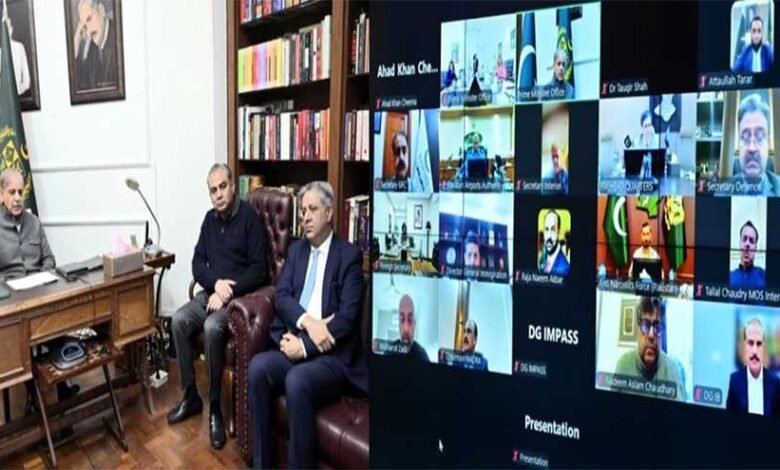
While presiding over a review meeting on the elimination of human trafficking and measures against unlawful travel abroad on Saturday, Prime Minister Muhammad Shehbaz Sharif emphasized the necessity of fully utilizing contemporary technologies to strengthen Pakistan’s immigration system.
The prime minister expressed gratitude to the appropriate institutions for their efforts to combat human trafficking.
He praised Federal Interior Minister Mohsin Naqvi for personally visiting airports to assess the issue, citing recent reports and complaints over the off-loading of passengers going overseas.
Read More: PM establishes committee to look into the problem of passenger unloading
He instructed that extra caution be taken to prevent inconvenience to passengers with legitimate travel documents when taking action against those who are traveling overseas unlawfully or with questionable travel documents.
In order to assist those who are lawfully traveling overseas for work, the prime minister further directed that the Protectorate of Emigrants’ performance be further enhanced and that cooperation with the Federal Investigation Agency (FIA) and other pertinent organizations be reinforced.
Strict action against corrupt elements was also ordered by the prime minister, who emphasized the importance of efficiency and transparency in the immigration system.
Participants in the conference received an update on the measures implemented to combat unauthorized international travel. It was reported that 451 people had been arrested by the FIA this year for their involvement in illicit travel and human trafficking.
The number of Pakistanis going illegally to Europe has decreased by 47% as a result of these efforts, and there has also been a decrease in the number of people traveling to the United Kingdom and Gulf countries on false documents.
The briefing pointed out that deportation, offloading, illegal migration, and the abuse of work and tourism visas continue to be significant issues in European nations. Passengers returning from Saudi Arabia, the United Arab Emirates, Iraq, Malaysia, and Oman accounted for the majority of deportations.