In the Urumqi negotiations, Pakistan makes three main demands.
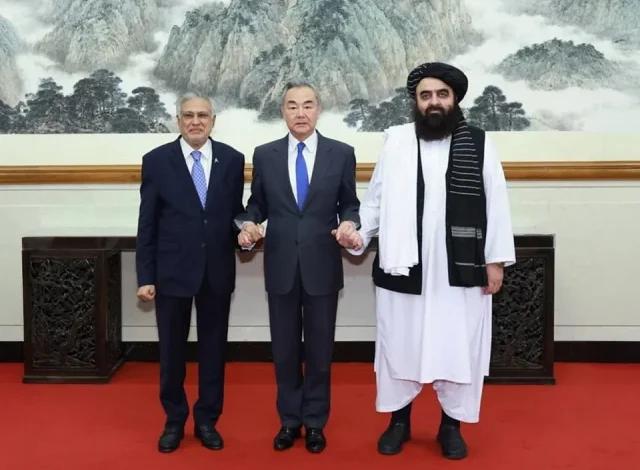
China, which mediated the most recent round of negotiations in Urumqi, is attempting to persuade both sides to agree on a five-point framework to address concerns, while Pakistan has sent three fundamental requests to the Afghan Taliban.
Islamabad’s first requests were for Kabul to legally designate the Tehreek-e-Taliban Pakistan (TTP) as a terrorist organization, destroy its infrastructure, and produce verifiable evidence of the action.
Pakistan’s bargaining stance, which sources claim has hardened due to ongoing security concerns, is based on these demands.
Thus far, the Foreign Office has only released a preliminary statement attesting to the fact that negotiations are occurring in Urumqi; it has not provided any additional information regarding the agenda or the status of the negotiations.
Tahir Andrabi, a spokesman for the Foreign Office, stated at the most recent weekly briefing that Pakistan’s involvement in the negotiations in Urumqi should not be seen as a change in policy, especially with regard to current security operations.”The ongoing Operation Ghazab Lil Haq that I mentioned last week has not changed significantly,” the spokesperson continued.
Afghan Foreign Minister Amir Khan Muttaqi said on Sunday that talks were still ongoing and that the Taliban government desired to use negotiations to settle disputes with Pakistan.
According to sources, China has been using persistent shuttle diplomacy to play a modest but active role. Yue Xiaoyong, the country’s Special Envoy for Afghanistan, has been interacting with both Islamabad and Kabul in recent months in an effort to resolve differences and get them to the negotiating table.
Additionally, Pakistan has made it clear that the discussions would only address border security and counterterrorism, excluding any more extensive political involvement at this time. According to the sources, the emphasis is on resolving Islamabad’s worries about terrorist organizations using Afghan territory and making sure that cross-border assault prevention measures are in place.
It is thought that a framework that could lead to a potential understanding between the two sides is being discussed. A ceasefire agreement, counterterrorism guarantees from the Afghan Taliban, the destruction of terror sanctuaries within Afghanistan, and steps to enable safe trade routes are all included in the proposed plan.
Additionally, it envisions the creation of a more formalized and structured discussion channel between Kabul and Islamabad.
Given the practical nature of the talks, both sides have dispatched technical delegations to Urumqi.
Syed Ali Asad Gilani, Additional Secretary at the Foreign Office in charge of Afghanistan and West Asia, is in charge of Pakistan’s team, which consists of representatives from intelligence and defense organizations.
Mohibullah Waseq, Amir Khan Muttaqi’s chief of staff, leads the Afghan Taliban team, which also consists of officials from the intelligence directorate, foreign ministry, interior ministry, and defense ministry.
According to the sources, Chinese officials are holding separate discussions with each side to close gaps before proceeding with direct, organized conversations, even though preliminary engagements have started.
Urumqi’s position in China’s Xinjiang region, where Beijing has long been concerned about militancy associated with groups like the East Turkestan Islamic Movement (ETIM), whose fighters are thought to be present in Afghanistan, makes the venue’s selection noteworthy.
Although significant gaps still exist and any progress would depend on Kabul’s willingness to address Islamabad’s fundamental security objectives, diplomatic watchers say the discussions mark a cautious but significant attempt to stabilize Pakistan-Afghanistan ties.