Japan publishes photo of snowman asteroid after flyby
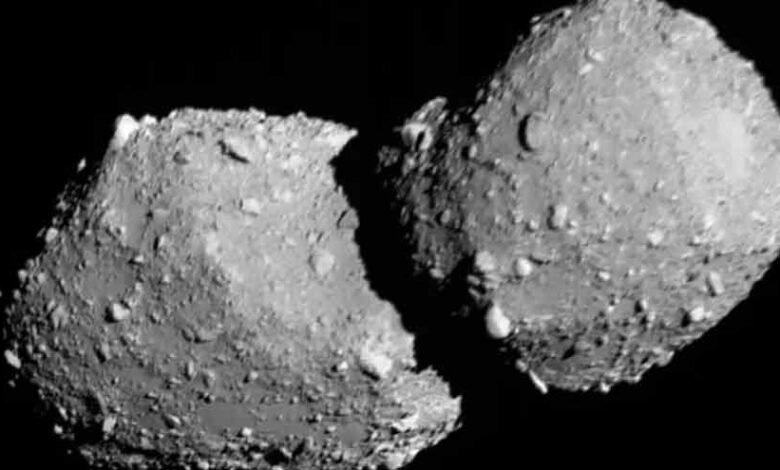
Rare pictures acquired by a Japanese space probe during a flyby of a near-Earth asteroid showed the space rock looked like a snowman, scientists claimed on Monday.
Hayabusa2, the size of a fridge, skimmed the asteroid Torifune on Sunday in a mission to show how to deflect a potentially dangerous space rock away from Earth.
A new image released Monday by the Japan Aerospace Exploration Agency (JAXA) could help with those attempts, with researchers stating near-Earth asteroids come in a variety of sizes, shapes and surface features.
“When I actually saw this image and the scientific data it gave me goosebumps,” JAXA scientist Yuya Mimasu told reporters. He said the asteroid “personally looked like a snowman”.
A telescope camera snapped a black-and-white photo that seemed to show two spherical objects connected together. You can actually see the rocks… I never really thought I would be able to shoot a photo like this so I’m just over the moon,” he said.
The mission follows a successful Nasa test in 2022 which modified the orbit of asteroid Dimorphos by purposely smashing a spacecraft into it. It was known that the Torifune was long but the details were unknown.
The probe, traveling at more than 18,000 kilometres (11,185 miles) an hour, was set to pass within 800 metres (2,625 feet) of the asteroid, but JAXA said the distance will be analysed later. If confirmed, it would be one of the closest flybys of a near-Earth asteroid ever.
JAXA also revealed on Monday that they had obtained data from three other instruments designed to estimate the distance from the asteroid and check for water. JAXA and the European Space Agency have teamed up on another so-called “planetary defense” mission, this time to study the asteroid Apophis, which will make a near flyby of Earth in April 2029.
Hayabusa2, launched in 2014, has already excited scientists with its landing and collection of samples from asteroid Ryugu, located about 300 million kilometers (185 million miles) from Earth.
Six years later, it delivered priceless samples from Ryugu — “dragon palace” in Japanese — to Earth, affording scientists information about what the solar system was like when born 4.6 billion years ago.
Following the Torifune mission the space probe is due to “rendezvous” with an asteroid known as 1998KY26 in 2031. The move involves flying alongside or touching down on the space rock to acquire precise data.