EU, Pakistan announce $74.6m deals to enhance business, clean energy, rule of law
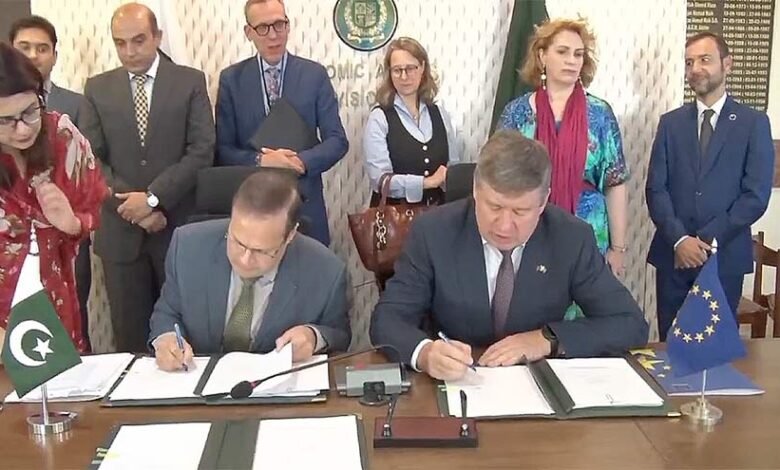
The European Union (EU) and Pakistan signed three grant agreements for €65 million ($74.6 million) on Monday that would assist Islamabad attract international investment, deliver renewable energy to off-grid populations in its northwest and improve access to justice, the information ministry said.
The awards are financed through the EU’s Multiannual Indicative Program 2021-2027 and are part of Global Gateway, the European Commission’s infrastructure investment agenda.
The plan intends to mobilize up to €300 billion ($344.6 million) in public and private investment globally in the period 2021-2027 in sectors such as technology, energy and transport.
The Pakistani government is focusing on attracting more foreign investment as it tries to achieve sustainable economic growth. In 2023 it created the Special Investment Facilitation Council, a hybrid government entity comprising both civilian and military leaders, to attract international investment to vital economic sectors.
Addressing the signing, EU Ambassador Raimundas Karoblis said: “These agreements reflect the EU’s commitment to Pakistan’s economic development and investment ambitions under our flagship Global Gateway initiative.”
The first program attempts to promote foreign investment by improving the taxation structure in Pakistan and by boosting the long-term financial planning of the government.
The second would increase renewable energy in rural villages in Khyber Pakhtunkhwa (KP) province that are not connected to the national grid. It will also train to attract private investment into the energy industry of the province.
The third, building on EU assistance before, will help individuals in Khyber Pakhtunkhwa and Balochistan access police, prosecution services, courts and legal aid.
Both provinces share a border with Afghanistan and have bore the brunt of extremist strikes in Pakistan in recent years. Research and data platform South Asia Terrorism Portal recorded 176 attacks and 438 deaths in Balochistan in July, the highest number of violence in the month, while KP recorded 143 occurrences and 244 fatalities during the period.
The same program will help Pakistan’s most populous and industrialized provinces, Punjab and Sindh, to expand alternative and commercial conflict resolution with the declared purpose of making them more appealing to European and other corporations seeking to invest.
The EU’s development partnership with Pakistan focuses on economic development, climate resilience, governance, rule of law, human rights and sustainable management of natural resources, the statement stated. The European Union (EU) and Pakistan on Monday inked three grant agreements for €65 million ($74.6 million) to assist Islamabad attract international investment, deliver renewable energy to off-grid populations in its northwest and improve access to justice, the information ministry said.
The awards are supported under the EU’s Multiannual Indicative Program 2021-2027 and are part of the European Commission’s infrastructure investment initiative, Global Gateway.
The plan intends to mobilize up to €300 billion ($344.6 million) in public and private investment globally in the period 2021-2027 in sectors such as technology, energy and transport.
The Pakistani government is focusing on attracting more foreign investment as it tries to achieve sustainable economic growth. In 2023 it created the Special Investment Facilitation Council, a hybrid government entity comprising both civilian and military leaders, to attract international investment to vital economic sectors.
Addressing the signing, EU Ambassador Raimundas Karoblis said: “These agreements reflect the EU’s commitment to Pakistan’s economic development and investment ambitions under our flagship Global Gateway initiative.”
The first program attempts to promote foreign investment by improving the taxation structure in Pakistan and by boosting the long-term financial planning of the government.
The second would increase renewable energy in rural villages in Khyber Pakhtunkhwa (KP) province that are not connected to the national grid. It will also train to attract private investment into the energy industry of the province.
The third, building on EU assistance before, will help individuals in Khyber Pakhtunkhwa and Balochistan access police, prosecution services, courts and legal aid.
Both provinces share a border with Afghanistan and have bore the brunt of extremist strikes in Pakistan in recent years. Research and data platform South Asia Terrorism Portal recorded 176 attacks and 438 deaths in Balochistan in July, the highest number of violence in the month, while KP recorded 143 occurrences and 244 fatalities during the period.
The same program will also help the most populated and industrialized regions of Pakistan, Punjab and Sindh, to increase alternative and commercial conflict resolution, with the declared purpose of making them more attractive for European and other corporations seeking to invest.
The EU’s development cooperation with Pakistan covers economic development, climate resilience, governance, rule of law, human rights and sustainable management of natural resources, the statement said.