Pakistan’s pilot will be first foreign astronaut to join China’s Tiangong space station
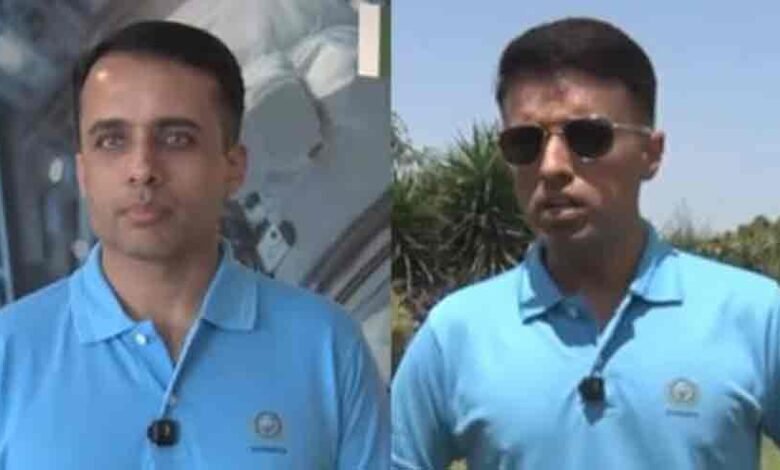
Two Pakistani pilots learning Mandarin who spin in centrifuge drills, eat, sleep and fix equipment weightless as a decision nears on who will be the first foreign astronaut inside China’s Tiangong space station.
For the South Asian nation, it would be the first space voyage. This is part of broader cooperation with Beijing that stretches beyond the Belt and Road Initiative and has seen Chinese-launched Pakistani satellites, a combined satellite-navigation system and a Pakistani-built rover set to fly on China’s Chang’e 8 lunar mission around 2028.
The two pilots, Zeeshan Ali and Khurram Daud, have been preparing for months at the China Astronaut Research and preparing Center in Beijing for a mission envisioned by the two countries in 2019, said Amer Gilani, who heads human spaceflight cooperation at Pakistan’s space agency, SUPARCO.
China has not announced which of the two would fly, or when, but Gilani said a final decision on the choice of astronaut should be taken in mid to late October.
Whoever is selected will not come back to Pakistan before the launch, but will go straight from training in China into space and come back home after a time of rehabilitation after coming back to earth, Gilani told Reuters in an interview.
“Training includes intensive Chinese language, learning spacecraft systems and adapting to the microgravity of orbit and the g-forces of liftoff,” he continued.
The pair overcame about 20 finalists from an initial group of Pakistani pilots and scientists who were evaluated for medical fitness, psychological resilience and, according to SUPARCO’s director of artificial intelligence Uzair Ansari, a tolerance for g-forces that few scientists have.”You don’t get many scientists who are used to travelling and experiencing high-level g-forces,” he added. That’s why the two men with backgrounds in high-speed flight were chosen.
SUPARCO has for the first time disclosed details about Gilani and Ansari to foreign media since the pilots were picked and deployed to China.
China’s space agency did not respond to a request for comment about the selection process.
SUBSTANTIAL PAYLOAD
Once in space, the chosen pilot will take the title of “payload specialist,” which is astronaut-speak for a person whose job in orbit is conducting Pakistan’s science projects instead of flying the ship, Ansari said.
Gilani said Chinese institutes had selected four of the more than 300 bids SUPARCO received from universities in Karachi, Lahore and Islamabad following a year-long campaign, for this flight: biotechnology projects that will help tackle food insecurity and climate change.
Before the Chinese engineers give their final nod, every experiment is constructed and pretested in SUPARCO’s own labs – a unique scenario, Ansari added, when Pakistani technology gets certified on an international scale.
“The scientific payload is quite modest compared to a station that has already hosted over 180 experiments and generated over 500 research papers and 150 patents,” Ansari said.
Combined, Tiangong’s three modules — Tianhe, Wentian and Mengtian — weigh about 77 metric tonnes and house about 14 experiment racks covering fields like life sciences, materials, fluid physics, combustion and radiation exposure, Gilani said. Some of the experiment racks are installed outside the station and are exposed directly to space for materials and biotechnology payloads.
DEPENDENCE ON BEIJING
The astronaut will travel on a Chinese-built spacecraft, launched from a Chinese facility, trained by Chinese instructors and spoken Mandarin in orbit.
Pakistan has no independent launch vehicle or crewed spacecraft, and the stay itself will be limited to approximately a week, a fraction of the nearly six-month rotations of career Chinese crew members.
The Pakistani astronaut is likely to return with two members of a Chinese crew that arrived in the space station in May, as the third member will remain for a year to facilitate the research of long-duration human physiology in space.
Since Yuri Gagarin’s first voyage in 1961, roughly 50 countries have had individuals fly in space, but only three — Russia, the US and China — have launched their own crewed spacecraft. China’s offer to Pakistan will be the first time it will ferry a foreign astronaut.
Asked whether Islamabad had received any assurance to send an astronaut to the moon under the same cooperation, Gilani said: “No official commitment or discussion on this matter has been made,” adding the future depends on the success of “our maiden mission.”
Separate strand of that cooperation is a Pakistani-built lunar rover set to fly on China’s Chang’e 8 lunar mission around 2028: it will use AI-based stereo imaging to detect obstacles, judge depth and plan its own path across the lunar surface, since Earth-based controllers cannot guide it in real time, Ansari said.
But Ansari said the mission is a “once-in-a-lifetime opportunity for Pakistani scientists.