World’s biggest particle smasher pauses for upgrading in dark matter hunt
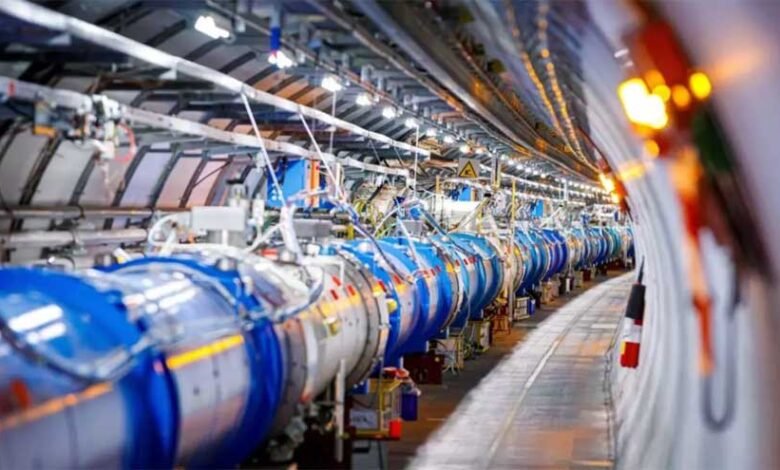
On Monday, the most potent particle accelerator in the world will cease operations for a four-year renovation that would significantly increase its collision capacity and the possibility of solving dark matter, one of the universe’s greatest mysteries.
The most well-known usage of the Large Hadron Collider (LHC), a 27-kilometer circular tunnel that smashes protons in the center of Europe’s physics facility CERN near Geneva, was to demonstrate the existence of the Higgs boson, also known as “the God particle.”
Superconducting magnets and accelerating structures in the tunnel, which is located approximately 100 meters below the French-Swiss border, drive particles to extremely high energy and then collide them at incredible speeds.
However, operations will cease on Monday when the remarkable apparatus is upgraded to significantly boost the accuracy and force of particle collisions.
After it is finished, the upgraded particle smasher, which will be known as the High Luminosity LHC (HL-LHC), is expected to start operating in June 2030 and run for roughly ten years.There are a lot of discoveries to come.This is a crucial time. We will be starting a new phase on Monday,” Markus Zerlauth, the head of the HL-LHC project, told reporters.Many physics questions remain unanswered. Numerous discoveries yet to be made.
In comparison to the LHC, the objective is to raise the “luminosity”—that is, the total number of collisions produced over a given period—by a factor of ten.
It is anticipated that the refurbishment will cost 1.2 billion Swiss francs ($1.5 billion) in total.
That will be paid by CERN membership fees, combined with in-kind contributions, amounting roughly 10-15 percent of the total, including from the United States, Japan, Canada and China.
1.2 kilometres of the 27-kilometer tunnel will need to have all of its components replaced as part of the refurbishment.
To boost the number of collisions, new superconducting magnets that can further concentrate the particle beams will be added.
Once operational, there will be between 140 and 200 collisions—up from the current 60—every time two particle packets collide inside the tunnel’s detectors.
According to Zerlauth, “the increased number of collisions will allow us to collect up to 100 times more data” overall.
There will be so many collisions—several billions every second—that it would be difficult to store all the information generated.
Artificial intelligence systems that can recognise the most promising incidents will be tasked with selecting which collisions should be recorded in real time.
However, Nedaa-Alexandra Asbah, a research physicist at CERN’s ATLAS experiment, which used the LHC to assist discover the Higgs Boson, argued that “AI does not replace physicists”It is an effective tool that enables us to utilise the data more effectively.
The Big Bang
The main goal of CERN is to increase basic knowledge, which is what the HL-LHC seeks to do.Filip Moortgat, CMS’s operations coordinator, stated, “We want to look for new particles.” The LHC detector is intended to investigate a variety of physics topics, such as the search for dark matter particles and other dimensions.
Only five percent of the cosmos, according to scientists, is made up of ordinary matter, which includes stars, gases, dust, planets, and everything on them.
Dark matter (27 percent) and dark energy (68 percent), two invisible substances that scientists have not yet been able to identify or directly study, are thought to make up the remainder.
The Higgs boson’s discovery in 2012 added a crucial piece to the jigsaw, expanding our knowledge of how particles get mass and earning physicists Peter Higgs and Francois Englert the 2013 Nobel Prize in Physics.
Once the upgrade is completed, CERN intends to greatly extend its understanding of how the “God particle” works, with the HL-HLC predicted to produce roughly 380 million Higgs bosons over its lifespan, compared to 55 million detected since LHC operations began in 2008.
Asbah stated that the lab’s primary goal is to create two Higgs Bosons at once, which would be a first, and observe their interaction.
This, she said, “may provide clues about how our Universe evolved shortly after the Big Bang”.