Prime Minister Shehbaz and Field Marshal Asim Munir advocate for national unity at the Ulema congress.
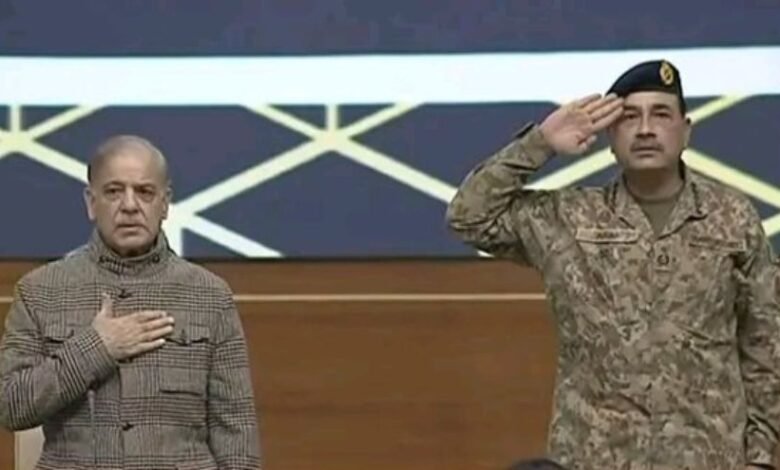
On Wednesday, Prime Minister Shehbaz Sharif advocated for the total elimination of sectarianism, extremism, and terrorism, calling religious academics to actively promote national harmony.
While addressing the National Ulema Convention in Islamabad, he cautioned that Pakistan’s advancement is contingent upon the decisive resolution of conflicting ideas.
Field Marshal and Chief of Defence Forces Asim Munir participated in the convention with Deputy Prime Minister Ishaq Dar, ministers, lawmakers, and scholars representing a diverse array of religious perspectives.
Sectarian dilemma
The prime minister articulated his worries as an urgent appeal, stating that sectarianism has emerged as a critical national issue requiring immediate response. He saw that whereas numerous intellectuals were striving for unity, some persisted in employing rhetoric that exacerbated separation. “Dismantling sectarianism is imperative,” he stated, emphasizing that the onus for fostering a climate of unity rests with both the government and religious authorities.
Prime Minister Shehbaz emphasized that Pakistan’s economic resurgence cannot coexist with terrorism. He stated that extremist factions, including khawarij members, were assaulting innocent civilians and security forces, with individuals in Balochistan and Khyber Pakhtunkhwa routinely becoming victims. “If this situation continues, how can the nation advance?” he inquired, underscoring that success will arise solely from persistent effort rather than expedients or superstition.
Triumph and watchfulness
Field Marshal Asim Munir, in his remarks to the conference, delineated a profound historical and spiritual linkage between the State of Madinah and the State of Pakistan. He stated that Pakistan had been entrusted with the duty of protecting the Haramain, a distinction he characterized as a divine blessing. He emphasized that nations that stray from knowledge and scholarship ultimately fall into disorder and strife, whereas dignity and power are attained through learning and effort.
He characterized terrorism as an Indian proclivity rather than a Pakistani one, asserting that the military forces engaged the adversary openly and resolutely. He reminded the audience that in the Maarka e Haq, Pakistan attained victory by divine assistance, the valor of its military, and the prayers of its populace. Field Marshal Munir asserted that only the state possesses the authority to proclaim jihad, and he urged scholars to foster national unity by expanding the collective viewpoint.
Economic forecast
Regarding the economy, Prime Minister Shehbaz stated that Pakistan had arrived at a pivotal moment from which it was poised to advance towards progress.
He attributed the nation’s avoidance of default to the collaborative efforts of political and military leadership. The prime minister stated that this is a moment for execution, discipline, and collective determination, asserting that austerity and national concentration are crucial for fulfilling the ambitions of Quaid-e-Azam Muhammad Ali Jinnah.
He stated that Pakistan’s allies were commemorating the nation’s recent military triumph and expressing pleasure in its accomplishments, while certain factions persisted in disseminating “toxic propaganda” against the armed forces. Disavowing such tales, he asserted that protecting the national interest was a collective obligation.
Field Marshal Munir closed his address by imploring scholars to uphold national unity and cultivate intellectual diversity among the populace.