The President reiterates Pakistan’s steadfast support for Kashmiris on Kashmir Solidarity Day.
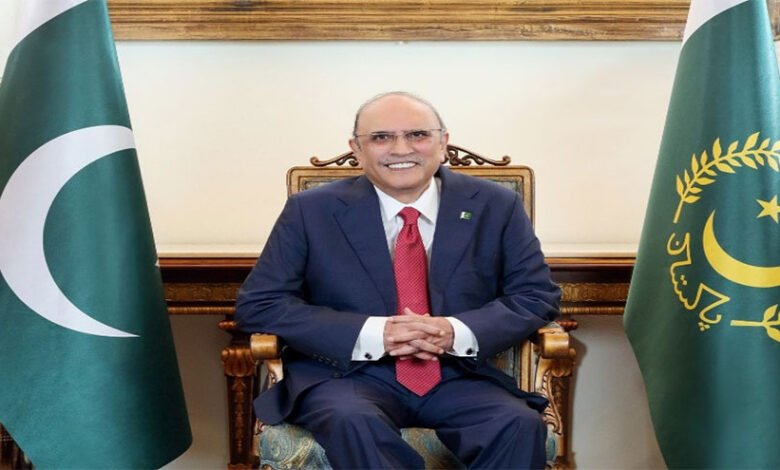
President Asif Ali Zardari has reaffirmed Pakistan’s unwavering moral, diplomatic, and political support for the Kashmiri people, emphasizing their intrinsic right to self-determination as outlined in the pertinent United Nations Security Council resolutions.
In his address on Kashmir Solidarity Day, celebrated on February 5, the president stated that the populace of Pakistan worldwide stands united with their Kashmiri counterparts in their rightful struggle.
He remembered that Kashmir Solidarity Day was established 36 years ago by Shaheed Mohtarma Benazir Bhutto in response to the historic Kashmiri uprising of 1989, a movement that persists to this day.
President Zardari stated that for nearly eighty years, they have remained resolute against what he described as unlawful Indian occupation, making significant sacrifices for their fundamental rights and liberties.
He articulated profound apprehension regarding the current circumstances in Indian Illegally Occupied Jammu and Kashmir (IIOJK), asserting that the unilateral and unlawful measures enacted on August 5, 2019, had exacerbated the suffering of the Kashmiri populace.
He stated that India had escalated efforts to solidify its authority via administrative and legislative actions, restricting media freedoms, imprisoning Kashmiri leaders, and seeking to modify the demographic makeup of the region.
The president emphasized what he characterized as severe human rights abuses by Indian occupation forces, referencing international reports indicating an increase in arbitrary detentions, collective punishment, and punitive demolitions of homes.
He stated that the curtailment of digital liberties, particularly the obstruction of several social media accounts, indicated efforts to obscure the actual conditions on the ground.
In reference to the recent profiling of mosques and mosque management committees in IIOJK, President Zardari characterized these acts as intentional intimidation designed to curtail the religious freedom of the Muslim majority community.
He asserted that such policies constitute a greater pattern of religious persecution and emphasized that Kashmiris possess an innate right to practice their religion free from fear or discrimination.
The president cautioned that the military escalation commenced by India in May 2025 highlighted the precariousness of peace in South Asia, asserting that enduring regional stability was unattainable without a fair resolution of the Jammu and Kashmir conflict.
President Zardari urged the international community to transcend mere expressions of concern and to compel India to cease human rights violations in IIOJK, permit unrestricted access to international human rights observers, and honor its commitment to granting Kashmiris their right to self-determination.
Reiterating Pakistan’s stance, he asserted that the nation would persist in supporting the Kashmiri people till they can ascertain their future through a free and impartial vote.