Two Indians are saved by a Pakistani laborer during the floods in Oman.
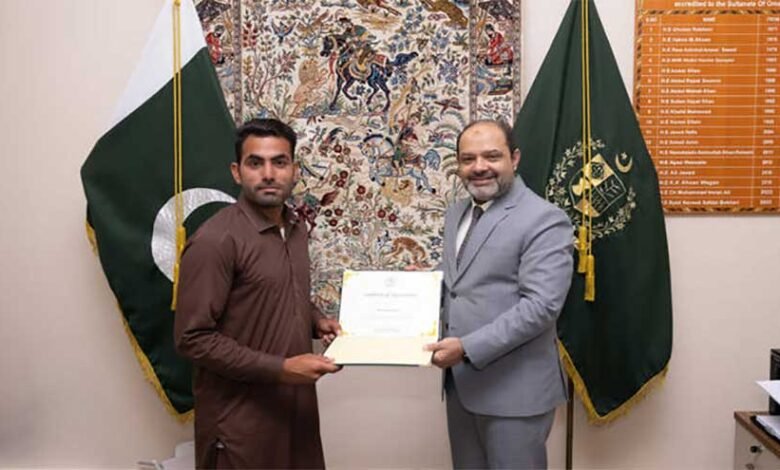
Despite long-tense relations between the two nations, a Pakistani laborer in Oman has been praised for saving two Indian citizens from a car that was swept away by flash floods. He claimed that this deed demonstrated humanity beyond boundaries.
A car was dragged into an overflowing wadi, a dry riverbed that can swiftly fill with heavy rain, in Barka, a coastal city west of Muscat, while hundreds of spectators gathered on a bridge above, many of them recording the event on their cell phones.
Shehzad Khan, a 25-year-old foreigner from Shabqadar in the northwest Khyber Pakhtunkhwa area of Pakistan, was one of them. Despite his inability to swim, he climbed aboard the car to help the men get to safety.
The incident, according to Khan, brought back memories of a catastrophe that occurred in his own nation in 2025 when 17 tourists—including 13 members of a single family—were swept away while onlookers watched and rescue efforts took a long time.
In a Zoom interview with Arab News, he said, “The first thing that came to mind was the Swat incident, the day that family was waiting for someone to rescue them, but no one came.”
“I have to save these people,” was the same human notion that crossed my mind.
On March 21, during the Eid Al-Fitr holidays, Oman was struck by a strong low-pressure system that transformed typically dry riverbeds into swift-moving flood channels. Khan made the rescue. At least ten individuals, including five children, have died as a result of the storms, according to the Civil Defense and Ambulance Authority (CDAA).
Three Indian nationals from Kerala lost their lives in a different incident in Barka alone the next day when their car was washed away, underscoring the risks associated with the flooding.
Khan claimed that after jumping onto the partially submerged car, he attempted to force open the rear door by kicking it first, breaking the glass with a stone thrown by a bystander, and then using force.
He remembered, “There were two men inside, one partially submerged in water and the other on top of him.”
After violently dragging the first man out, Khan rushed for the second, who seemed to be “taking his last breaths” but was eventually saved.
“I was thinking only about humanity at the time,” Khan remarked. “I didn’t give a damn if the individuals in the automobile were Indian or from another nation. When the Indian men embraced me, I felt the most contentment and delight.
Since then, his deeds have gone viral, and the Pakistani embassy in Muscat has given him a certificate of appreciation.
His incapacity to swim made the rescue “unparalleled,” according to Ambassador Syed Naveed Safdar Bokhari, who called him a “national hero.”
For Khan, who is employed and has finished his intermediate schooling, the focus has been on what he perceives as a unique opportunity to unite two countries that are frequently at odds.
He remarked, “The Indians have shown a lot of love and admiration for my action.” “I think it would be good if people of India and Pakistan always maintain good relations with each other, despite the ongoing differences between them.”
Khan resumed his normal life when the floodwaters subsided, but his family in Pakistan is finally acknowledging his deeds.
“My mother, father, and sisters are all very content. He grinned and continued, “My father is proud that our Pakistan is recognized in this way.”
He maintained that while the acknowledgment was encouraging, the deed itself was more important.
He said, “I did this for humanity and then forgot.” “I saved them for Allah’s pleasure, and all I know about them is that they were Indians.”