Rubio anticipates a discussion on religious freedom with Pope Leo following Trump’s criticism of the church.
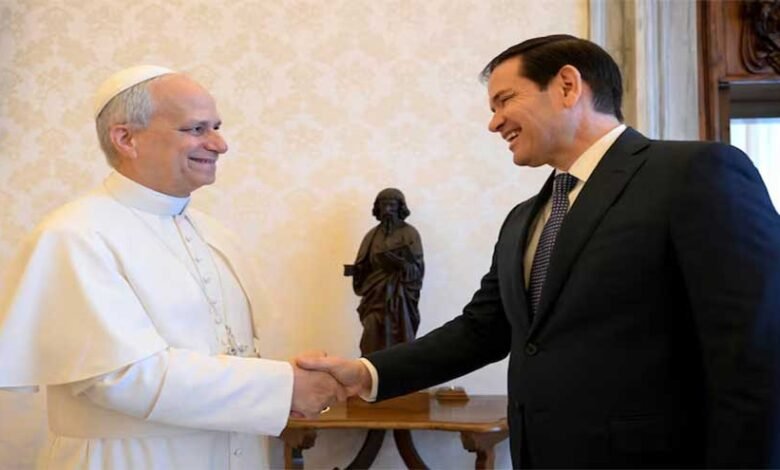
US Secretary of State Marco Rubio stated on Tuesday that he anticipates discussing Cuba and global religious freedom concerns with Pope Leo during his visit to the Vatican on Thursday, following President Donald Trump’s recent criticism of the pope for denouncing the US-Israeli conflict with Iran.
The US envoy to the Holy See had stated that Rubio and the pope would “engage in a candid discussion regarding US policy.””Nations experience conflicts, and I believe one method to resolve these is through camaraderie and genuine dialogue,” stated Ambassador Brian Burch.
In Washington, Rubio informed reporters at the White House that he anticipated discussing global religious freedom, particularly in Africa, and humanitarian assistance to Cuba with the pope.Rubio stated, “There is much to discuss regarding the Vatican.” The pope is unequivocally the vicar of Christ, a Roman Catholic, and concurrently the leader of a sovereign nation-state.We collaborate with the Catholic Church in the dissemination of humanitarian assistance in Cuba. He stated that we share with the Catholic Church a concern regarding the erosion of religious liberty, the persecution of Christian minority, and the issues confronting Christians in Africa.
Trump has consistently denigrated the first U.S.-born pope in recent weeks, eliciting a backlash from Christian leaders across the political spectrum.
Rubio stated that his visit to the Vatican was scheduled prior to Trump’s discord with the pope.Rubio said, “No, I mean it’s a trip we had previously planned, and clearly, certain events transpired.” This was in response to a question regarding whether the trip was Washington’s effort to reconcile with the pope.
On Monday, Trump informed right-wing radio host Hugh Hewitt that “the Pope prefers to discuss the acceptability of Iran possessing a nuclear weapon, which I find concerning.”
Leo has never asserted that Iran should possess nuclear weapons; nonetheless, he has opposed the war that Trump claims is intended to terminate Iran’s nuclear development.
Tehran, without nuclear weapons, refutes any intention to acquire them but asserts its entitlement to develop nuclear technology for peaceful use, including enrichment, as a signatory of the Nuclear Non-Proliferation Treaty. The United States possesses nuclear weapons.
In response to Trump’s criticism, Leo stated his intention to disseminate the Christian message of peace while acknowledging individuals’ freedom to critique him.The Church’s goal is to disseminate the Gospel and promote peace,” stated the pope. “Should anyone wish to critique me for proclaiming the Gospel, I merely desire to be heard due to the significance of God’s words.”
Leo unequivocally dismissed the notion that he endorsed nuclear weapons, which the Catholic Church deems evil. “The Church has consistently opposed all nuclear arms; there is no doubt about that,” he stated.
Rubio will discuss discrepancies with the Pope.
Rubio and Vice President JD Vance are both Catholic. The two encountered Leo a year prior after participating in his debut service.
Burch was enquired at a function at his embassy at Rome’s Gregorian University on Tuesday whether Rubio was seeking to mend Trump’s connection with Leo.The ambassador stated, “I reject the notion that there exists a profound divide.” Burch stated that Rubio is arriving so that the US and the Vatican may enhance mutual understanding and address any potential disagreements through dialogue.
On Friday, Rubio is scheduled to confer with Italian Prime Minister Giorgia Meloni, who has advocated for the pope. The Iranian conflict jeopardises US leadership, according to her defence minister.
Leo, who on Friday commemorates his first anniversary as the leader of the 1.4-billion-member Catholic Church, initially had a relatively quiet profile on the global scene during the early months of his papacy but has recently emerged as a staunch critic of the war in Iran.
The pope has vehemently condemned the Trump administration’s stringent anti-immigration measures. He has advocated for dialogue between the United States and Catholic-majority Cuba, which has experienced recurrent blackouts due to US sanctions that Washington claims are intended to exert pressure on Cuba’s single-party Communist regime.