On PM’s instruction, the PIMS fire incident inquiry report was made public.
The inquiry report of the extremely unfortunate fire incident in Pakistan Institute of Medical Sciences (PIMS) was made public on the directions of Prime Minister Muhammad Shehbaz Sharif.
According to the Prime Minister’s office, the Inquiry Committee, constituted on 26.08.2026 to enquire into the fire incident in Pakistan Institute of Medical Sciences (PIMS), presented its interim report to the Prime Minister on Saturday.
The committee presented the facts gathered so far, available video of the incident and its interim recommendations to the Prime Minister.
This Interim Report records only those facts and prima facie findings presently supported by the available evidence.
Matters requiring forensic, technical or documentary reconciliation, including the precise ignition source, the causal contribution of particular deficiencies and final fixation of individual responsibility, are expressly reserved for the comprehensive report. The Committee has throughout distinguished between what ignited the fire, what enabled it to become catastrophic, and who was responsible for preventable failures.
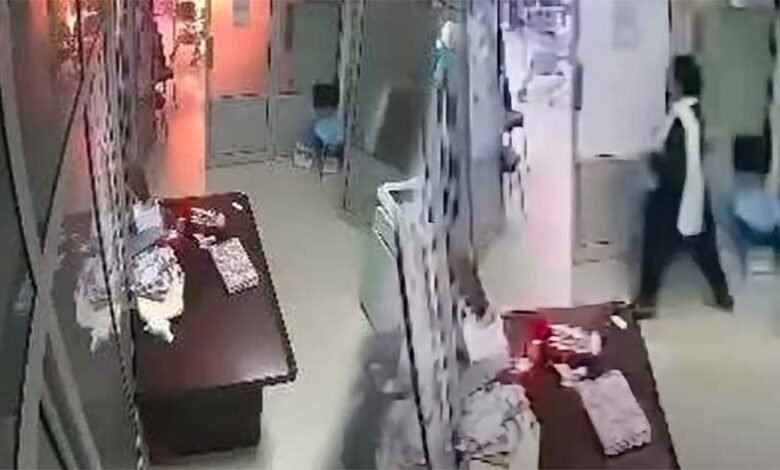
CCTV footage presently provides the most objective reconstruction of the incident. The first visible emergency appears at approximately 06:38:15, when Charge Nurse Nasreen hurriedly emerges from the Nursery and seeks assistance. At approximately 06:38:35, she and Security Guard Maria enter the Nursery, with reflections of flames visible. Staff Nurse Razia enters at approximately 06:38:56 and emerges at about 06:39:04 carrying a baby, thereby effecting a rescue.
She attempts to re-enter shortly thereafter. Dr. Abdul Rehman emerges at approximately 06:39:12, while by about 06:39:15 Camera 16 is substantially obscured by smoke.
The adjoining corridor door visible on Camera 12 is opened at approximately 06:39:45, and by about 06:40:08 Camera 12 is also obscured by smoke. This evidence therefore establishes that the Nursery environment deteriorated catastrophically within approximately two minutes.
The precise technical source of ignition is not yet conclusively established. Various accounts attribute the fire to an AC, incubator/warmer or electrical short circuit/plug overloading. IESCO records do not indicate a contemporaneous external feeder fault or tripping, thereby shifting any electrical causation inquiry downstream to PIMS’s internal electrical distribution, sockets, plugs, wiring and connected equipment.
Preventive maintenance records also indicate that several incubators had recently been serviced and returned in working condition, although those records do not conclusively establish electrical safety of the equipment, plug, socket or associated circuit.
Accordingly, an internal electrical/equipment related origin remains plausible, but it would be premature to identify any particular appliance or component as the established cause.
The Committee considers it important that uncertainty regarding the first spark should not prevent examination of the protective systems that should have prevented an initial fire from becoming a mass fatality event.
The cause of ignition and the causes of the consequences are related but analytically distinct.