Trump rejects Tehran’s response and declares a “life support” ceasefire with Iran.
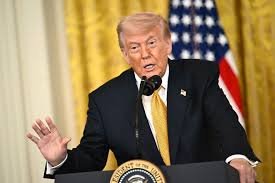
Following his rejection of Tehran’s answer to a US peace proposal, President Donald Trump declared on Monday that a truce with Iran was “on life support,” raising fears of a resumption of hostilities in the 10-week confrontation that has claimed thousands of lives and stopped essential energy flows.
Iran on Sunday released a response aiming at ending the war on all fronts, including Lebanon, where US ally Israel is battling Iran-backed Hezbollah fighters, days after Washington proposed to resume talks. Trump had quickly dismissed the statement.
On Monday, Trump responded to questions about the status of the truce.After reading that piece of rubbish they sent us, I would say that it is now the weakest. He remarked, “I didn’t even finish reading it.”
In response, Tehran emphasized its sovereignty over the Strait of Hormuz, requested compensation for war damage, and urged the US to lift sanctions, remove a prohibition on Iranian oil shipments, stop its naval blockade, and ensure no more strikes.
Before beginning negotiations on more divisive topics, such as Iran’s nuclear program, the US had suggested ending hostilities.
On Monday, Tehran defended its position.According to Foreign Ministry spokesperson Esmaeil Baghaei, “Our demand is legitimate: demanding an end to the war, lifting the (US) blockade and piracy, and releasing Iranian assets that have been unfairly frozen in banks due to US pressure.”Iran’s additional demands, which are regarded as a kind and responsible offer, included safe passage via the Strait of Hormuz and the establishment of security in the region and Lebanon.
As the impasse kept the Strait of Hormuz mostly closed, Brent crude oil futures increased 2.7% to about $104 per barrel. One-fifth of the world’s oil and liquefied natural gas were transported over the small river prior to the start of the war on February 28. Since then, it has emerged as a key area of contention.
OPEC oil output fell further in April to the lowest level in more than 20 years due to disruption brought on by the strait’s impending closure, according to a Reuters survey released on Monday.
SHIPPING TRICKLE THROUGH HORMUZ
Compared to before the conflict, there is far less traffic across the Strait of Hormuz. Three tankers carrying crude left the channel last week with trackers turned off to prevent an Iranian strike, according to shipping data on Kpler and LSEG.
Days after the first such cargo crossed under an agreement between Iran and Pakistan, the data revealed that a second Qatari LNG tanker was trying to cross the strait.
A ceasefire that has halted full-scale combat since it went into force in early April has been put to the test by sporadic flare-ups throughout the strait in recent days.
Less than six months before national elections that will decide whether Trump’s Republican Party maintains control of Congress, surveys in the US indicate that the conflict is unpopular with people who must deal with substantially increased petrol costs.
NATO partners have refused to send ships to reopen the waterway without a comprehensive peace agreement and an internationally mandated mission, making it difficult for Washington to garner international backing.
According to a Turkish diplomatic source, Hakan Fidan, the country’s foreign minister, will conduct talks in Qatar on Tuesday about the fighting and how to ensure navigational safety in the strait. Turkey has been in regular contact with the US, Iran, and mediator Pakistan since the war began.
In Beijing, Trump is scheduled to talk about Iran.
It’s uncertain what the following military or diplomatic actions will be. On Wednesday, Trump is scheduled to arrive in Beijing, where he will speak with Chinese President Xi Jinping on a number of issues, including Iran.
Trump has been urging China to use its clout to persuade Tehran to reach an agreement with Washington.
Baghaei, a spokesman for Iran’s Foreign Ministry, proposed that China may utilize the visit to oppose US goals in the Gulf. “Our Chinese friends know very well how to use these opportunities to warn about the consequences of the US’ illegal and bullying actions on regional peace and security,” he stated.
In comments broadcast on Sunday, Trump stated, “They are defeated, but that doesn’t mean they’re done,” when asked if combat operations against Iran had ended.
According to Israeli Prime Minister Benjamin Netanyahu, there is “more work to be done” in order to remove enriched uranium from Iran, demolish enrichment facilities, and deal with its ballistic missile capabilities and proxy troops.
Although he did not rule out the use of force, Netanyahu told CBS News’ “60 Minutes” that diplomacy was the preferable course of action.
Despite an announcement on April 16 of a ceasefire mediated by the United States, fighting between Israel and Hezbollah has also persisted in southern Lebanon.