Trump, stung by the Iran War, travels to China in search of victories
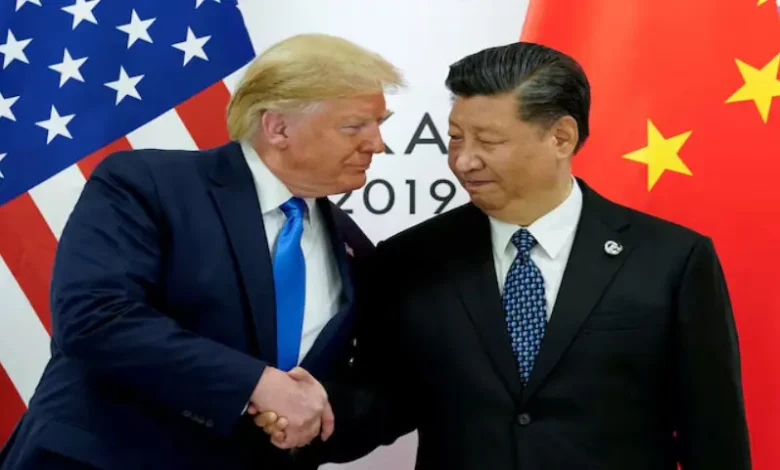
Donald Trump, the president of the United States, forecast a year ago that high trade tariffs would force America’s primary economic adversary to back down.
According to political commentators, he is traveling to China this week with that ambition tempered by court decisions, limiting his objectives to a few deals on beans, beef, and Boeing jets and asking China for assistance in ending his unpopular Iran war.
According to commentators, the low expectations for Trump’s meetings with Xi Jinping on May 14–15, the first since they halted a brutal trade war in October, highlight how Trump’s extravagant strategy has failed to provide an advantage before the talks.
Alejandro Reyes, a professor at the University of Hong Kong who specializes in Chinese foreign policy, stated that Trump “kind of needs China more than China needs him.”
Reyes continued, “He needs a kind of foreign policy victory: a victory that shows that he is looking to ensure stability in the world and that he is not just disrupting global politics.”
China has subtly refined its economic pressure toolbox directed at Washington since their previous brief encounter at an airbase in South Korea, where Trump froze triple-digit tariffs on Chinese imports and Xi retreated from restricting global supplies of rare earths.
Prior to the midterm elections in November, Trump’s approval ratings have been negatively impacted by his battle against US court orders opposing his tariffs and a conflict with Iran.
The leaders will have a summit at the Great Hall of the People, visit the Temple of Heaven, a UNESCO-heritage site, eat at a state banquet, and have tea and lunch together at this week’s meeting in the Chinese capital.
However, officials engaged in the planning stated that it is still unclear whether the leaders will even agree to extend their trade truce, and the expected economic deliverables amount to a few agreements and systems to govern future trade.
CEOs like Tim Cook of Apple and Elon Musk of Tesla will accompany Trump, albeit the corporate group is less than it was on his previous trip to Beijing in 2017.
In addition to trade, Trump stated on Monday that he will talk to Xi about arms sales to Taiwan and the imprisoned media magnate Jimmy Lai.
Trump is being urged by the families of two Americans who have been detained in China for almost ten years to pursue their release.
“We’re doing great with China now, but we used to be taken advantage of for years with our previous presidents,” Trump declared. “I hope he respects me as much as I respect him (Xi).”
One conflict after another
Since Trump said in a Truth Social post in April 2025 that his tariffs would make China realize that the “days of ripping off” the United States were finished, the mood music has drastically changed.
These taxes forced Beijing to impose restrictions on rare earth exports, ruthlessly exposing the West’s reliance on materials essential to the production of everything from weaponry to electric automobiles. This ultimately resulted in the precarious truce between Trump and Xi.
Since then, Trump has engaged in numerous additional conflicts, such as seizing the leader of Venezuela, threatening to invade Greenland, a fellow NATO member, and fighting Iran, which has caused havoc in the Middle East and fueled a worldwide energy crisis.
According to a Reuters/Ipsos study conducted last month, almost 60% of Americans are against his war in Iran.
Trump now wants China to persuade Tehran to reach an agreement with Washington to put an end to the war.
China continues to be a significant buyer of Iran’s oil exports and maintains relations with the country.
At a seminar in Taipei last week, Matt Pottinger, who was Trump’s deputy national security advisor during his first term, stated that although China would prefer an outcome that diminishes American strength, it is not exempt from the financial consequences of a lengthy confrontation.
However, Beijing will demand something in exchange, and Xi’s main priority is Taiwan, the democratically run island that China claims.
Even a slight alteration in Washington’s wording would cause concern about the commitment of Taipei’s most significant supporter, which would have an impact on other U.S. allies in Asia, even though some dread a deal that may give China the confidence to seize Taiwan by force.
Trump should make it clear that he “won’t support independence or take actions that encourage a separatist political agenda,” according to Wu Xinbo, a professor at Shanghai’s Fudan University and member of China’s foreign ministry’s strategic advisory board.
“Superficial cease-fire”
According to persons briefed on the talks, China also wants the Trump administration to pledge not to take punitive trade actions in the future, such as export restrictions on technology, and to remove current restrictions on sophisticated memory chips and chipmaking equipment.
Additionally, Beijing has been strengthening its own economic power since last October by tightening its rare earth license regulations and passing legislation to penalize foreign companies that move their supply chains away from China.
According to a Chicago Council on Global Affairs survey released in October, the majority of Americans (53%) now believe that the United States should engage in cordial cooperation and engagement with China, up from 40% in 2024.
Therefore, Trump may be able to declare victory by just maintaining good ties and extending the trade war truce.
According to Scott Kennedy of the Center for Strategic and International Studies think tank in Washington, the primary result is probably going to be “a superficial ceasefire that is largely to China’s advantage.”